
Grégoire Courtine
Spinal cord researcher
Grégoire Courtine and his interdisciplinary lab imagine new ways to recover after devastating, mobility-impairing injury to the spinal cord.
Why you should listen
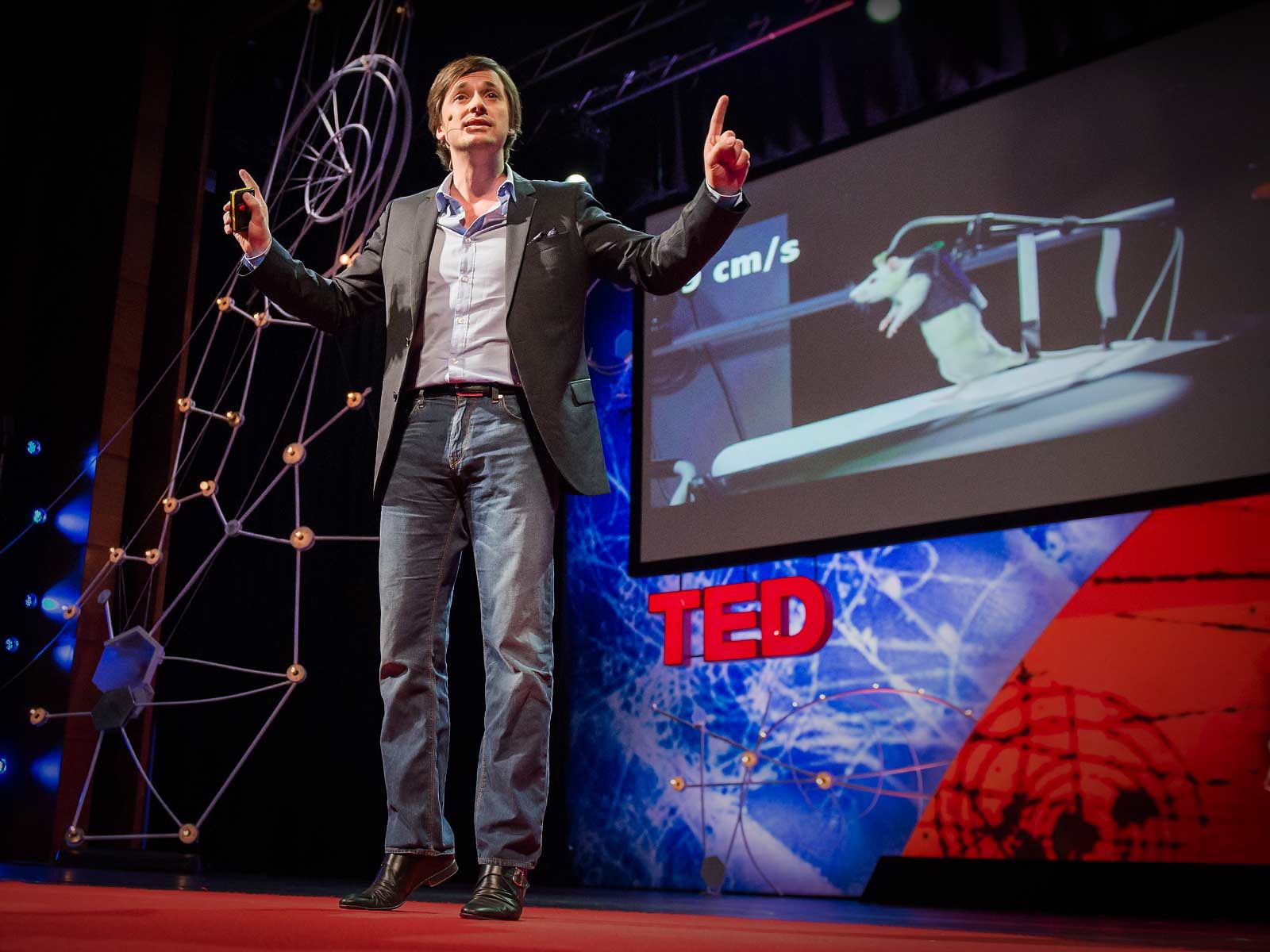
In a lab in Switzerland, a little white rat is re-learning how to walk. In research dubbed Project Rewalk, Grégoire Courtine and his collaborators are figuring out how a spinal cord with a severe lesion might repair itself, to the point that voluntary locomotion could happen again -- not just reactive movement but brain-directed walking and running. The treatment involves a re-awakening cocktail of chemicals released onto the spinal cord, combined with electrical stimulation -- plus repeated exercise that rehearses the walking movement. As part of the experiment, Courtine's team developed a robot that gently supports the rat vertically but does not push it forward; the rat has to decide to move on its own. And eventually, it does. As Courtine explains, "the training forces the brain to recruit what is left of the neural system to get the job done."
Courtine holds the International Paraplegic Foundation chair in spinal cord repair at the Center for Neuroprosthetics at the Swiss Federal Institute of Technology in Lausanne.
What others say
The new study is the most comprehensive and rigorous presentation to date of what is possible, and the Swiss research team is already working on technology to test the techniques in humans.
Grégoire Courtine’s TED Talk
More news and ideas from Grégoire Courtine
In Brief
Wireless advances in treating spinal cord damage, morphing wings for aircraft, and the world’s tallest tropical trees
November 22, 2016
Just a few of the intriguing headlines involving members of the TED community this week: Advances in treating spinal cord damage. In Nature, Grégoire Courtine and a team of scientists announced that they had successfully used a wireless brain-spine interface to help monkeys with spinal cord damage paralyzing one leg regain the ability to walk. […]
Continue readingScience
A promising first step for those with spinal cord injury: Further reading on electrical stimulation and how it’s helped rats (and one human!) walk again
November 6, 2013
Grégoire Courtine and the scientists in his lab helped a paralyzed rat learn to walk again, voluntarily, through a treatment that combined drugs, electrical stimulation of the lower spinal cord, the support of a robotic arm and a little bit of chocolate. When their study appeared in the June 2012 issue of Science, it sparked […]
Continue readingLive from TEDGlobal
Hey, that paralyzed rat just walked upstairs: Gregoire Courtine at TEDGlobal 2013
June 12, 2013
Grégoire Courtine is the head of the Center for Neuroprosthetics and Brain Mind Institute of the Life Science School at the Swiss Federal Institute of Technology Lausanne (EPFL). He starts his TED Talk with a story of a mentor of his, the late Christopher Reeve, who spent the last years of his life in a wheelchair after a paralyzing spinal […]
Continue reading