
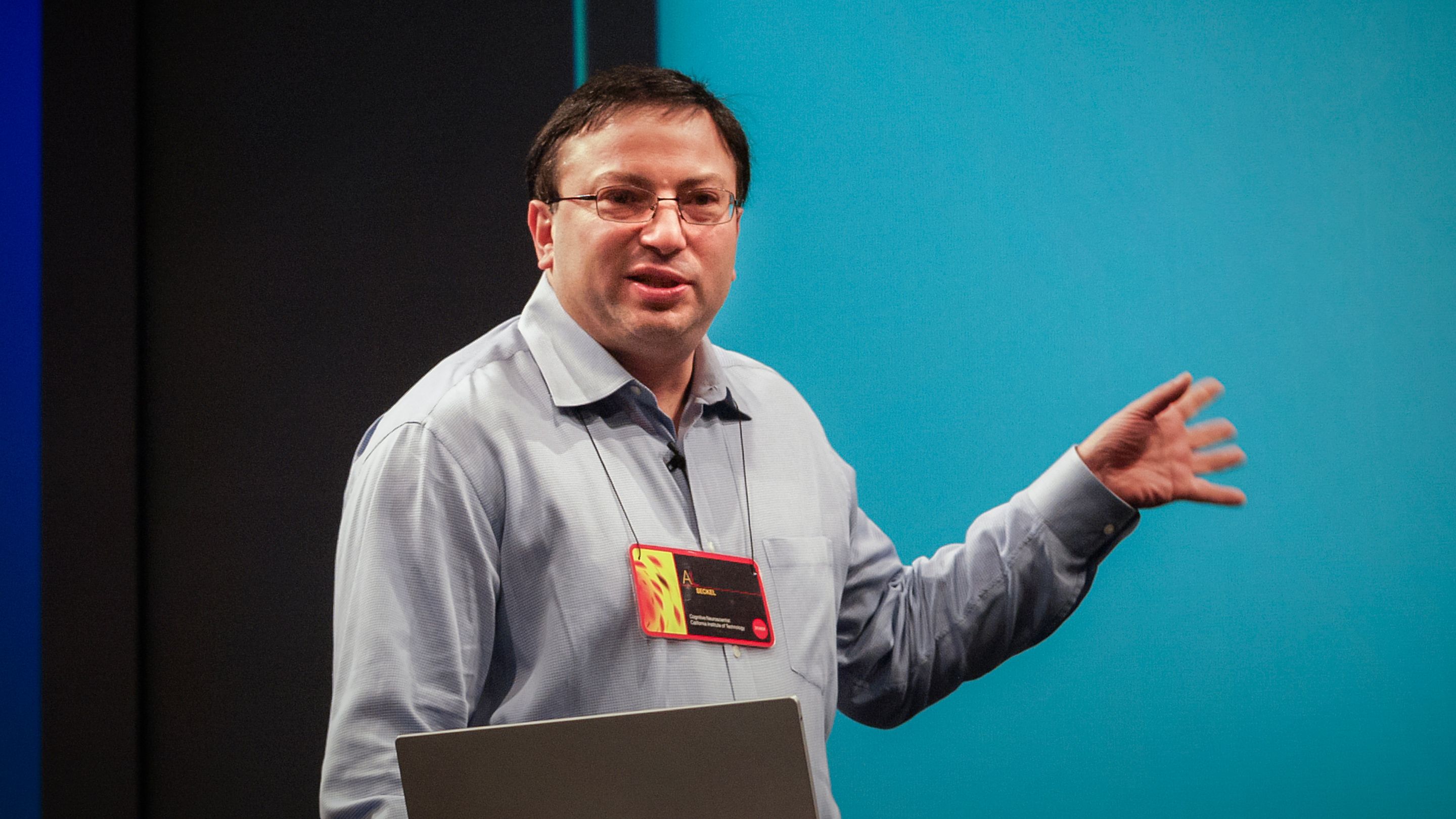
Al Seckel explored how eye tricks can reveal the way the brain processes visual information -- or fails to do so. Among his other accomplishments: He co-created the Darwin Fish.
Why you should listen
Al Seckel took great delight in visual illusions and the brain mechanics that they reveal. The author of many books and articles, he also designed interactive museum exhibits around the world that allow visitors to play with illusions and understand how they work.
A noted lecturer, he was a member of the Edge Foundation, a founder of the Southern California Skeptics, a campaigner against the teaching of creationism in public schools -- and co-creator of the Darwin Fish. Seckel died in 2015. Watch his 2010 talk from TEDxUSC: "[Y]Our Mind's Eye" >>
Note: A previous version of this biography described Seckel as a "cognitive neuroscientist," which was not accurate.
What others say
Al Seckel is acknowledged as one of the world's leading authorities on illusions.
Al Seckel’s TED Talk
More news and ideas from Al Seckel
Uncategorized
Warp your room (not your mind) with this awesome illusion
April 10, 2009
Via speigl.org via verylowsodium: Instructions: 1. Stare at the image for 10 seconds 2. Look at something — your hand, a book, your friend 3. Enjoy! For more on illusions — and the delight of our buggy minds — see Al Seckel’s 2004 TEDTalk >>
Continue readingUncategorized
Which direction is this woman spinning?
October 13, 2008
Can you reverse her direction of rotation? Cognitive Daily at ScienceBlogs took a reader poll and found that two-thirds saw the silhouetted woman rotating clockwise. About the same number were able to reverse her direction. Those who initially saw the woman rotating counter-clockwise found it easier to reverse her direction — much as the Necker […]
Continue readingUncategorized
How easily we are fooled: The rotating grid illusion
September 21, 2008
Filmmaker and animator David O’Reilly (who came up with the concept for iHologram) has noticed an interesting property in this animated GIF: He writes: While working in 3D last year, I discovered this optical illusion: A large grid seen rotating at a certain speed will appear to group itself into smaller grids, spinning independently. See […]
Continue reading