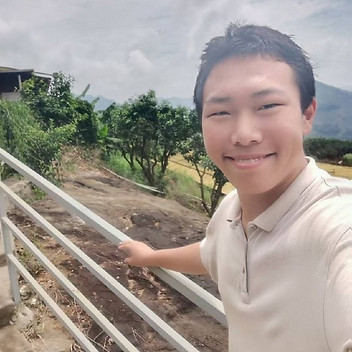
About Wang
I am a…
Activist, Explorer, Social entrepreneur, Student, Writer/Editor
Bio
I'm graduated from Xin Education and Ming Shu and is currently pursuing a bachelor's degree in Traditional Chinese Medicine at INTI International University in Malaysia. I'm the member of the Malaysia Shandong General Chamber of Commerce,Malaysia Yunnan General Chamber of Commerce, a member of the Chinese Anti-Cancer Association, a volunteer with the Red Cross, and a TED translator (ranked among the top 20 globally, serving as language supervisor for English, Chinese, and Malay regions). At university, he served as a member of the External Relations Department of the INTI China Student Union, president of the Football Club, and vice-president of the Music Club. He has received numerous awards in international competitions, including but not limited to medical, scientific, and sports categories, and has frequently participated in international medical summits and inter-university lecture events as a volunteer.
I'm passionate about
Unified coordination is not about making everyone march in the same direction — it's about helping each person see that they already share a common destination.
Business is not a battlefield, and foreign trade is not a zero-sum game. What we call "unified coordination" is really about creating a shared language — one that allows people from different cultures and positions to see each other's true needs, and then piece together "your leverage" and "my底线" into a win-win puzzle.
Why is this so important today?
We live in a fractured era. In business, we see U.S.-China decoupling, geopolitical games, and supply chain anxiety. In human relationships, algorithms trap us in echo chambers. We've become increasingly skilled at talking to people who agree with us — and increasingly incapable of collaborating with those who don't.
But it is precisely in this fractured era that the value of the "connector" is rising sharply.
I want to share three principles that have served me well to this day:
First, see the person before you see the deal.
The starting point of every negotiation is not numbers, but trust. A Dung's social insurance wasn't a cost — it was his bottom line. The Middle Eastern businessman's demand for exclusivity wasn't greed — it was his trauma. If you only stare at the spreadsheets, you'll never see the human heart.
Second, translate disagreement into a common language.
The core skill of unified coordination is translation. Translate "we need a lower price" into "we need to reduce costs together to weather the risk." Translate "your terms are too harsh" into "we want a fairer safety net." The essence of translation is admitting that everyone wants dignity, security, and a sense of accomplishment — we just express it differently.
Third, be a long-term "weaver of the net."
A true master of external relations isn't the one who drinks the other side under the table at a banquet. It's the one who, along a long industrial chain, keeps finding the quality nodes that others overlook — those quiet, rule-abiding, conscientious people — and then weaves them into a larger network. That network has a name: the trust network.
A few years ago, a research institute asked me: What is your proudest achievement? It wasn't making more money. It wasn't signing a big deal. It was that time in Vietnam, when A Dung said to me after signing the contract: "You are the first person who ever asked me why I buy social insurance for my workers."
That simple sentence reminded me: In a world that chases efficiency and profit every single day, the people who are willing to pause, bend down, and ask "why" — those are the ones who truly change the world.
Business is the space where people meet. External relations is the bridge that turns strangers into trust. Foreign trade is the channel through which goods carry civilization. And unified coordination is the ability to turn all voices into harmony.
I hope you, too, can become a "connector" in your field — not through negotiation tactics, but by seeing the beating heart behind every silent person.
An idea worth spreading
A good traditional Chinese doctor needs to possess international capabilities.
If traditional Chinese medicine is truly effective, why should it only be promoted and accepted among the Chinese and Chinese descendants?
Being self-righteous will only lead to stagnation. For you, traditional Chinese medicine is the medicine of Chinese culture. But for me, traditional Chinese medicine is indeed the medicine of humanity.
People don't know I'm good at
1.Translation and Languages
2.Social media
3.Therapy
4.Find opportunity