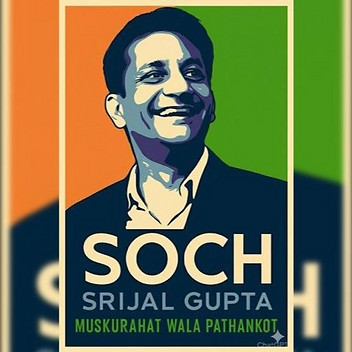
About Srijal
I am a…
Educator/Teacher
Bio
Srijal Gupta is an education reformer and social innovator working to redefine opportunity for students in India’s small cities and rural regions. As the founder of the “Global Exposure Ecosystem” model, he has brought world leaders, diplomats, authors, technologists, and changemakers into classrooms that traditionally lacked access to such experiences. Through TEDxCaledonian and a series of international youth initiatives, he has helped students gain confidence, global awareness, and future-ready skills. Srijal’s work is driven by a simple belief: geography should never decide a child’s destiny.
An idea worth spreading
A child’s future should not depend on their pin code.
Talent is universal, but access to opportunity is not. My idea is to build a model that brings global exposure, world-class learning, and future-ready skills to students in India’s smaller cities and rural regions — so that geography no longer decides destiny.
When children meet global thinkers, use modern tools, and work on real-world problems, something extraordinary happens: their imagination expands. They begin to see themselves as part of a larger world. They dream differently. They act differently. And entire communities transform.
This is an idea worth spreading because it reframes education not as a system of information, but as a gateway to possibility. If we can give millions of children access to the world — its ideas, its innovations, its people — we can unlock a generation of confident, capable, globally aware citizens who will shape the future of India and beyond.
The TED story
I grew up in a part of India where opportunity rarely arrived. Dreams were modest, exposure was limited, and most young people believed that the world existed far away from them. I wasn’t supposed to think globally — but life had a different plan.
As I stepped into education, I saw the same pattern repeating itself in the next generation: bright, curious children held back not by talent, but by the walls of geography. It troubled me deeply. I kept asking myself one question: What would happen if the world reached them before they grew up?
So I started bringing the world to them — literally. Diplomats, former prime ministers, global thinkers, innovators, authors, technologists — people who never imagined speaking in a small city — walked into our classrooms. Students who had never met a foreign visitor were suddenly asking questions about global politics, science, AI, diplomacy, sustainability.
And something changed.
Their confidence shifted.
Their imagination expanded.
Their dreams grew bigger.
This wasn’t an event. It was a transformation.
Watching a child from a non-metro city speak to a world leader with clarity and courage made me realize something simple and powerful:
Exposure is not luxury. Exposure is equity.
This insight has shaped my purpose. My work today is driven by the belief that geography should never decide destiny. If a school in Pathankot can evolve through global exposure, technology, and real-world learning, then so can thousands of schools across India.
I am not building a project.
I am building a doorway — one that opens the world to children who were never expected to step into it.
And once they see what lies beyond that doorway, they never think small again.