Timber Hawkeye
Author - non fiction, inspirational new thought at Buddhist Boot Camp
TED Translator
United StatesAbout Timber
I am a…
Change agent, Public servant, Writer/Editor
Bio
To make a long story short, I sat there in front of the Tibetan Lama, wearing my maroon robes after years of studying Buddhism and said, "With all due respect, I don't believe the Buddha ever intended for his teachings to get THIS complicated!"
My teacher looked around at all the statues of deities with multiple arms and chuckled, "The Buddha didn't do this! The Tibetan culture did because this is their way. Why don't you try Zen? I think you'd like it!"
So, I bowed-out of the temple, took off my robes, and moved into a Zen monastery far from home. I was determined to find a simpler depiction of the Buddha's valuable teachings.
My teacher was right; Zen was simpler (the walls were blank and I loved it), but the teachings were still filled with all the dogma that sent me running from organized religion in the first place.
There are many incredible books out there that cover all aspects of religion, philosophy, and psychology, but I was looking for something less "academic," so to speak. I was looking for something inspirational that people today would not only have the attention span to read all the way through, but actually understand and also implement into their daily lives. I pictured a book called "A guide to being a Buddha" with only two words in it: "Be kind."
Thus, Buddhist Boot Camp came to be, then Faithfully Religionless, and The Opposite of Namaste. Each book is an invitation to put compassion into action, so having partnered with the Mental Health Association, the Veteran Health Administration, and the Prison Library Project, public school teachers use the books as part of the required reading curriculum, therapists prescribe the books as medicine to their patients, yoga instructors share excerpts in their classes, and chaplains are using the books with those who are incarcerated at various correctional facilities around the world. Since Buddhism is all about training the mind, and boot camp is an ideal training method for this generation's short attention span, the chapters in the books are short and easy to understand. Each story, inspirational quote, and teaching, offers mindfulness-enhancing techniques to which anyone can relate.
It is very possible (and perfectly okay) for people who are Catholic, Muslim, or Jewish, for example, to still find the Buddha's teachings motivational. As the Dalai Lama says, "Don't try to use what you learn from Buddhism to be a Buddhist; use it to be a better whatever-you-already-are.
There is absolutely no reason to argue over which religion came "first" or whose philosophy is "better." The important thing is to be kind, understanding, peaceful, patient, and compassionate, which is actually fundamental in all religions and schools of thought.
Whether it's Mother Teresa's acts of charity, Gandhi's perseverance, or your aunt Betty's calm demeanor, it doesn't matter who inspires you, so long as you are motivated to be better today than you were yesterday. Regardless of religion or geographical region, race, ethnicity, color, gender, sexual orientation, age, ability, flexibility, or vulnerability, if you do good, you feel good, and if you do bad, you feel bad. Amen! Hallelujah! And all that Jazz!
If you agree that Buddhism isn't just about meditating, but also about rolling up your sleeves to actually relieve some of the suffering in the world (both within and around us), then you are a Soldier of Peace in the Army of Love. Welcome to Buddhist Boot Camp!
I'm passionate about
Buddhist Boot Camp: encouraging people to promote what they love instead of bashing what they hate.
An idea worth spreading
TED challenged us to come up with the important elements that will dictate the success of our future cities, and I believe true success means being happy. So, if we're going to design a successful city, we need to make sure that the people in it are happy. But, how do we do that? We've been so terribly misguided by the notion that happiness is something we have to pursue, and it's in that pursuit of happiness that we have actually lost our way. Instead of chasing happiness like a hamster on a wheel, I say slow down... sit. A few minutes each day to take inventory of everything in your life worth appreciating is the first step we can each take to guiding the next generation away from a growing sense of entitlement, which is nothing short of an epidemic, and toward a deeper appreciation for life itself. Let's lead by example and plant seeds of compassion in the minds and hearts of the next generation so that they can sprout into the most empowered and optimistic leaders of tomorrow.
The TED story
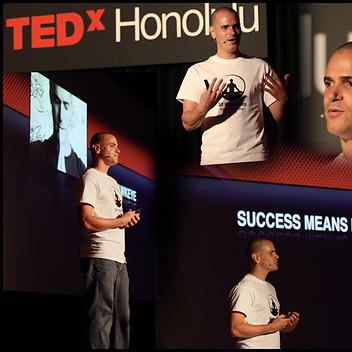
Speaker at TEDx Honolulu - A day of urban inspiration http://youtu.be/LIFTxRJfLTM