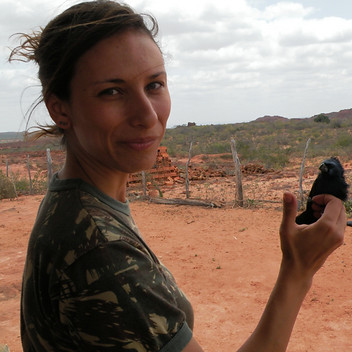
About Juliana
I am a…
Activist, Athlete, Change agent, Concerned citizen, Environmentalist, Explorer, Scientist, World traveler
Bio
Juliana Ferreira is a dedicated professional with expertise in counter wildlife trafficking, conservation genetics, and wildlife forensics. With a Ph.D. in Biology (Genetics), Juliana's research focuses on the population genetics of Brazilian bird species affected by illegal wildlife trade. She plays a pivotal role in FREELAND Brasil, a non-profit organization dedicated to combating wildlife trafficking in South America through education, law enforcement support, and public policy engagement. Juliana's work involves strengthening national and international frameworks for wildlife crime regulation, enhancing detection and investigation of transnational trafficking, and fostering collaboration through trust networks. Her efforts include establishing a wildlife forensic genetics lab to aid law enforcement and advocating for the phasing out of legal wildlife trade.
I'm passionate about
Wildlife, Forensics, Science, Yôga, Swimming, good music and books, true friends, rescuing stray dogs and cats...
An idea worth spreading
First and foremost, animals of wild species should not be kept as pets. The possiblity of lega trade of animals of wild species makes law enforcement much more difficult, since agents must be able to tell legal from illegal animals in the trade.
In this sense, since there is legal captive breeding throughout the world to fill the consumer market for wild pets, I strongly believe that all animals of wild species that were bred in commercial breeders to be sold as pets should have their individual DNA genetic profile sequenced and this information should be part of the required documentation for trade (when possible, for some species this would not be so straightforward). This genetic information cannot be faked such as other marks - microchips or legbands - and would allow for easy counter-proof at any time. This would greatly aid the control of the trade of wild pets and help law enforcement agents tell legal animals (actually captive bred) from animals which were illegally stolen from nature and would be enter the legal market as if they were bred in captivity.
At least until the day when people realize that wild animals belong in nature.
Areas of expertise
Conservation genetics, Education, Endangered species, Illegal wildlife trade, Public health, Species protection, Wildlife conservation, Wildlife forensic genetics
The TED story
My TED story couldn't have began in a better way: I attended the 2009 conference at Long Beach and gave a talk at TED University! I also had the honor of being selected as one of the 2010-2012 TED senior fellows. And on TED 2010 I also gave a TEDU talk which made it to TED.com. The repercussion was instant. Having a talk on TED.com has helped me to spread the problem of illegal wildlife trade in Brazil and the issue of what to do with the seized animals. Also, being at TED and interacting with so many people amazing people,who are so accomplished and are still wanting to accomplish gave me even more hope and energy to keep on with my project of saving the world (!). The TED experience was a unique and special experience which I will always treasure and cherish.
People don't know I'm good at
swimming, making "brigadeiro, teaching, kicking doors down