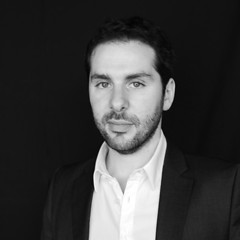
About Rafael
I am a…
Concerned citizen, Connector, Consultant, Social entrepreneur, Writer/Editor
Bio
Rafael Tyszblat is an expert in conflict resolution, mediation, and intercultural dialogue with 15 years of experience. He has trained thousands of youth and adults to equip them with effective communication skills and facilitated even more conflicted group discussions.
As a dialogue facilitator, Rafael specializes on the relationship between “Western” and “predominantly Muslim” societies. He designs and leads facilitated dialogue programs between youth from North America, Europe, North Africa and the Middle East as well as within European societies between members of antagonistic communities.
He is the Director of Programming at the Muslim-Jewish Conference (www.mjconference.org), a grassroots interreligious organization that he represents in France. He recently launched the initiative of a Coalition of Civil Society Organizations for Intercultural and interconvictionnal Dialogue through his organization called Connecting Actions (www.connectingactions.net).
Based in Paris, France, he is the Innovation and Program Design Manager at Soliya (www.soliya.net), an online based NGO promoting the field of Virtual Exchange (online intercultural dialogue).
He is a member of the European Mediation Institute (www.euromediation.com), an organization that brings certified mediators, trainers and coaches together to advance multi-disciplinary mediation practices in schools, companies and communities.
Between 2006 and 2009, as a manager and researcher at Meta-Culture (www.meta-culture.in), an integrated conflict resolution center based in Bangalore, India, he tested best practices in mediation, accompanied multicultural teams and facilitated group processes in different settings, including schools, families and the work place.
Rafael is trained in several schools of conflict resolution including those provided by the Institut de Formation du Mouvement pour une Alternative Non Violente (IFMAN) and the Centre de Médiation et de Formation à la Médiation de Paris (CMFM). His praxis combines Carl Rogers’ Person Centred Approach, emotional intelligence, the teachings of neurosciences, Transactional Analysis and Non-Violent Communication. His interventions challenge communication habits, help understand identity dynamics and promote a different way of dealing with our relations.
Rafael received his Master’s in Philosophy in International Relations from Paris I Panthéon Sorbonne University and has a MA in Conflict Resolution from University of Bradford in West Yorkshire, England. He received another MA from Paris Institute of Political Science (Sciences-Po).
I'm passionate about
Human beings really: their biology, psychology and culture. What connects or disconnects them. And their relationship to (their) nature.
An idea worth spreading
We all have something to say. But who is listening? We all think we’re right. But isn’t it bothering to have so many different and contradicting opinions, ideologies, all shouted with the same strength of conviction?
We are not doomed to clash. We can change but we first need to know the mechanisms that govern us, our minds and bodies. Deep dialogue can help us be true to ourselves and to others.
Now this idea is coming from a privileged person. And dialogue is often understandably perceived as a luxury that especially the most powerful can see value in. For the people on the lower side of the power balance, dialogue is not a priority. The priority is social change and justice whereas dialogue is about making peace, potentially at the cost of normalizing an unfair situation. Dialogue and mediation have had bad press in a world where some people are the victims of inexcusable acts.
I am saying that, even if our search is for justice, we need to ask ourselves those questions: what if our main motivation was power? And what if underneath that struggle for power was in fact the struggle for survival? We need to pay attention to the fact that even when we are lower on the power balance, we may not just be looking for justice but also for the same thing that got us oppressed: power. Thereby, we might just be fighting to maintain the very system that we no longer want to be a victim of.
Our drive to dominate others is natural but it is not inevitable. Which is why, even as I am aware of my privilege, I want to put forward the idea that conciliating our need for justice and our readiness to remain non violent in our actions can only serve our well being and a better society.
I want to show that mediation and dialogue are not about making bad compromises. They are not about budging on Human Rights. Their value is to make sure that, in trying to defend ourselves, we don’t end up contributing to the escalation of violence.
Areas of expertise
Conflict Resolution, Curriculum Design, Dialogue, Interconvictional dialogue, Intercultural communication, Mediation, Training, Virtual Exchange
Things you might not know
Singing