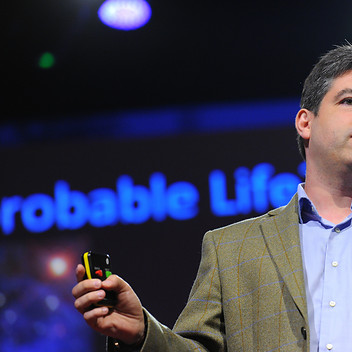
About Lee
I am a…
Brainstormer, Concerned citizen, Designer, Educator/Teacher, Engineer, Entrepreneur, Idea generator, Inventor, Scientist, Technologist
Bio
Lee Cronin graduated with a first class honours degree in Chemistry in 1994 and his DPhil. In 1997, both from the University of York. After postdoctoral research at Edinburgh University and as an Alexander von Humboldt Research Fellow in Germany, he returned to the UK as a lecturer at the University of Birmingham in 2000. In 2002 he moved to take up a Lectureship in Glasgow and was promoted to Reader in 2005, Professor in 2006, and was appointed to the Gardiner Chair of Chemistry in April 2009 and at 38 years old he is the youngest chair holder at the University of Glasgow. He holds both an EPSRC Advanced Research Fellowship and a Royal Society-Wolfson Research Merit Award, and is a Fellow of the Royal Society of Edinburgh, Scotland’s National Academy of Science and Letters. He runs a group of around 40 people, has around £10 M in research income, and his research interests range from the mainstream e.g. inorganic molecules, energy applications, nanoelectronics to trying to engineering ‘inorganic-life’, understanding self assembly at the nanoscale, as well as investigating the design / emergence of complex self organising chemical systems. His ultimate research aim is nothing less than the development of inorganic biology and evolution perhaps even leading to intelligent systems. To date he has published over 190 papers and given over 150 lectures around the world, and one of his papers describing the non equilibrium self assembly of a gigantic nanostructure was highlighted on the front cover of Science in January 2010.
I'm passionate about
Research and discovering something truly remarkable and new about the Universe / world we live in as well as developing new routes to innovation using radical science ideas as the catalyst and vision.
An idea worth spreading
Organic biology, the stuff of life on earth is not the only example of biology in the Universe. It is a subset of inorganic biology which encompasses all matter and uses evolution, just like organic biology, to develop fit systems that can adapt to many different environments. If proven (and this is my idea / obsession / aim), this will change the way we view our place in the Universe, look for ET, build and design new technologies, as well as developing robust physical systems that can cope with change and develop 'smart' reactions. This is because I aim to build inorganic biology in the lab, not in a few million years, but in less than 2-3 years using a combination of smart chemistry and smart reaction / reactor formats. The key to this system is very simple (I cannot reveal it here) but its simplicity will allow us to test a whole host of new ideas, not least, the new definition of life: Matter than can evolve.
Areas of expertise
3d manufacturing of complex molecules, 3d printing and rapid prototyping, artificial life and evolution, Chemistry, complex systems, Energy, inorganic biology, nanoscience, non conventional computation, Synthetic Biology
The TED story
I was invited to take part in TEDGlobal2011 to present my ideas in the area of 'inorganic biology' and the modern origin of life chemical simulator / exploration system we have been building in Glasgow during the past two years. I am now back at TEDGlobal2012 to talk about 3d printing and personal configurable chemistry for drug design and molecular assembly
People don't know I'm good at
Negotiating, innovating in virtually any space, computer programming, maths, remembering, challenging people to think radically outside their comfort zone, being stupid, playing with metaphysics