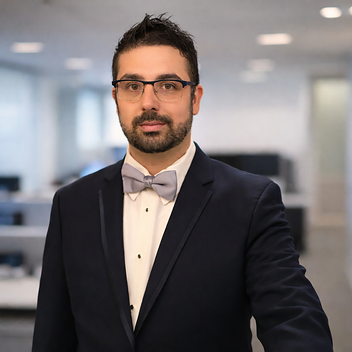
About Saul
I am a…
Change agent, Connector, Educator/Teacher, Event planner, Explorer
Bio
Saúl Beceiro Novo is a nuclear physicist, educator, and science communicator dedicated to connecting cutting-edge research with society. He is a Ramón y Cajal Research Fellow at the Universidade da Coruña (Spain), where he leads the FiTNAE (Nuclear and High Energy Physics and Technology) research group and develops advanced instrumentation for nuclear physics, particle physics, neutron imaging, radiation detection, and environmental applications.
Throughout his career, Saúl has worked at internationally recognized research institutions, including the Facility for Rare Isotope Beams (FRIB) and Michigan State University in the United States, collaborating on large international experiments at CERN, RIKEN, RCNP Osaka, GSI, and other leading laboratories. His research focuses on developing innovative detector technologies and experimental methods that enable scientists to answer fundamental questions about matter while creating practical solutions in fields ranging from medicine and industry to environmental monitoring.
Beyond research, Saúl is deeply committed to education and public engagement. He has taught university physics courses in both Europe and the United States, mentored students at every stage of their academic careers, and developed open educational resources to make high-quality physics education more accessible worldwide. He believes that universities have a responsibility not only to generate knowledge but also to share it in ways that inspire curiosity, critical thinking, and informed public dialogue.
Science communication has become a central part of his professional mission. He has organized numerous scientific meetings, outreach events, and public engagement initiatives, always seeking new ways to bring researchers closer to the communities they serve. He previously served on the organizing team for TEDxGalicia@USC and was also selected as one of its TEDx speakers. That experience reinforced his belief that powerful ideas emerge when people from different disciplines, cultures, and experiences come together in meaningful conversation.
Throughout his career, Saúl has sought to create opportunities for dialogue between academia and society. He is passionate about science communication and believes that some of the world's most important advances occur when people from different disciplines, cultures, and experiences come together to exchange ideas. Whether through research collaborations, public outreach, education, or international initiatives, he strives to make science more accessible and to foster conversations that inspire curiosity, creativity, and innovation.
Outside the laboratory, Saúl enjoys mentoring young scientists, building international collaborations, and exploring new ways to communicate complex ideas to broad audiences. He believes that curiosity is humanity's greatest driver of progress and that every breakthrough begins with a question worth asking.
I'm passionate about
I am passionate about using knowledge to create positive change, whether through scientific discovery, education, or service to society.
As a nuclear physicist, I am fascinated by understanding the universe and developing technologies that have real-world impact, from advanced scientific instrumentation to radiation detection and neutron imaging. I believe that research should not remain confined to laboratories but should be shared openly and translated into solutions that benefit society.
Education is equally important to me. Throughout my career I have taught and mentored students in Europe, the United States, and Africa, and I am particularly committed to expanding access to high-quality higher education. Every year I teach at the African Institute for Mathematical Sciences (AIMS) in Senegal, where I have the privilege of working with exceptionally talented students from across the African continent. These experiences have reinforced my belief that talent is universal, while opportunity is not. Promoting diversity, inclusion, and equal access to education has become one of the guiding principles of both my professional and personal life.
Outside academia, I have a deep passion for wildlife conservation and animal welfare. While living in the United States, I collaborated with several organizations dedicated to the conservation of endangered parrots and native lizard species, contributing to habitat restoration, species monitoring, and public education initiatives. Working alongside conservationists reminded me that solving complex problems requires collaboration across disciplines and communities.
Whether I am building scientific instruments, teaching students, protecting biodiversity, or organizing public outreach events, I am driven by the same belief: that curiosity, collaboration, and the open exchange of ideas can improve lives and help build a more sustainable, equitable, and compassionate world.
An idea worth spreading
Curiosity is humanity's most powerful technology. Every scientific discovery, artistic masterpiece, social movement, and technological breakthrough began with someone asking a question that others had not considered. In a world increasingly shaped by algorithms and specialization, our ability to remain curious, challenge assumptions, and learn from people with different perspectives is more valuable than ever. Universities should not only create knowledge but cultivate curiosity and share it with society. When curiosity is combined with collaboration across disciplines, ideas become innovations that improve lives.
Areas of expertise
artificial intelligence for scientific imaging, detector instrumentation, diversity and inclusion, environmental radiation, higher education, international collaboration, mentoring, neutron imaging, Nuclear physics, open science, particle physics, radiation detection, radon, research leadership, science communication, STEM education, wildlife conservation
The TED story
My TED story began at TEDxGalicia@USC, where I had the opportunity to serve as both a member of the organizing team and a speaker. That experience transformed the way I think about science communication and public engagement. I saw how a well-crafted talk could bridge disciplines, connect people from different backgrounds, and inspire action through the power of ideas.
Since then, I have built my career around sharing knowledge beyond academia. As a nuclear physicist, educator, and Ramón y Cajal researcher at the Universidade da Coruña (UDC), I develop advanced scientific instrumentation while working to make science accessible to society through teaching, outreach, and international collaboration. My experiences teaching at AIMS Senegal, mentoring students across three continents, and working on wildlife conservation projects have reinforced my belief that the greatest innovations emerge when diverse perspectives come together.
Organizing a TEDx in my university now that I am a faculty member myself is a natural continuation of that journey. My vision is to create a platform where researchers, entrepreneurs, artists, educators, and community leaders can share ideas that transcend disciplines and inspire curiosity, collaboration, and positive change. I hope this newTEDx becomes a lasting tradition at the University—one that showcases the incredible ideas being developed within our community while connecting them with the wider world.
Things you might not know
Most people know me as a nuclear physicist, but few know that some of my favorite moments happen far away from the laboratory. I have played the guitar for many years and find that music offers a creative balance to scientific research. I also volunteer in wildlife conservation and have worked with organizations in the United States dedicated to protecting endangered parrots and native lizard species. Whether I am helping monitor wildlife, mentoring students, or performing on stage with a guitar, I enjoy activities that connect people with nature, creativity, and one another.
People are often surprised that I enjoy organizing communities as much as conducting experiments. I genuinely love bringing together researchers, students, artists, and professionals from different backgrounds because I have found that the best ideas often emerge from unexpected conversations. Teaching at AIMS Senegal each year has reinforced my belief that talent exists everywhere, and I find great fulfillment in helping others discover opportunities they may never have imagined.
In many ways, these interests aren't separate from my scientific career—they reflect the same curiosity that first drew me to physics: understanding the world, appreciating its complexity, and helping others do the same.