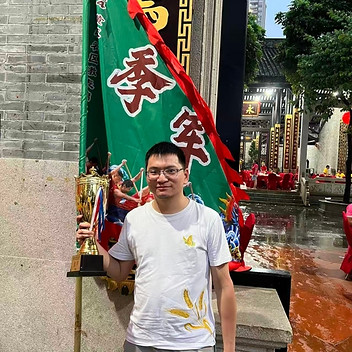
Terry Li
Manager of Student Quality Development at Affiliated School of JNU for Hong Kong and Macao Students (ASJ) Guangzhou Campus
TEDx Organizer
Guangzhou, ChinaAbout Terry
Bio
I am the Manager of Student Quality Development at the Affiliated School of JNU for Hong Kong and Macao Students (ASJ) in Guangzhou. In my role, I oversee students' extracurricular activities — what we call the "Five-Ring Classes" — which cover sports, arts, languages, technology, and community engagement. My job is to create opportunities for students to explore their passions beyond the classroom.
I have been an educator for nearly 20 years. Over this time, I have seen how a single opportunity — a stage, a project, or a kind word — can change a young person's path. That is why I am so drawn to TEDx. It is not about perfect speeches or public speaking practice. It is about giving students a real platform to share ideas that matter to them.
I'm passionate about
I am passionate about Cantonese songs.
Growing up, Cantonese songs were always around me. From old classics to modern hits, the lyrics are poetic and full of emotion. They tell stories about love, struggle, family, and hope. Even now, when I listen to a Cantonese song, I feel connected to my roots and to the culture of the Greater Bay Area.
As a teacher, I sometimes share Cantonese songs with my students. I want them to appreciate the beauty of our local language and the rich history behind the music. Many young people today listen mostly to English or Mandarin pop songs. That is fine, but I believe Cantopop has its own special magic. It carries the voice of our people.
When I feel tired or stressed, I put on some old Cantonese songs and sing along. It relaxes me and reminds me who I am. That is why Cantonese songs are my true passion.
An idea worth spreading
My favorite TED talk is "Do schools kill creativity?" by Sir Ken Robinson.
I first watched this talk years ago, and it honestly changed how I see education. Before that, I thought my job was simply to help students pass exams and follow rules. Ken Robinson made me stop and ask: am I helping my students grow, or am I training them to fit into a system?
His humor and honesty hit me hard. He told stories about young children who were labeled as having "problems" simply because they thought differently. That reminded me of some of my own students—the ones who struggled in traditional classrooms but had amazing imaginations.
This talk is one of the reasons I became an educator who cares about creativity, not just test scores. I want my students to be curious, to take risks, and to trust their own ideas. Ken Robinson gave me permission to believe that this matters.