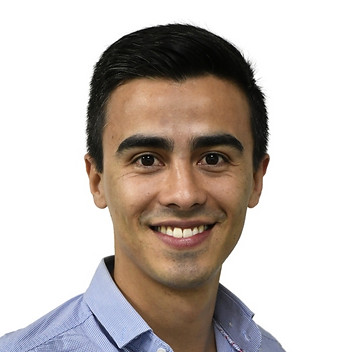
Luis Miguel Jaramillo
Director Latam at Conecta Iberoamérica
TEDx Organizer
Rionegro, Antioquia, ColombiaAbout Luis Miguel
I am a…
Business adviser, Connector, Consultant, Educator/Teacher, Project manager, Social entrepreneur
Bio
Colombian engineer, strategist, and changemaker who has spent over a decade working at the intersection of innovation, entrepreneurship, and human development across the Ibero-American region. With a background in Administrative Engineering and a specialization in Project Management, both earned with distinction from the Escuela de Ingeniería de Antioquia, Luis Miguel built his early career in the private sector, navigating the worlds of asset management, corporate finance, and executive strategy at firms like BTG Pactual and Aon. Those years taught him something fundamental: that technical expertise only truly matters when it is placed in service of people. That conviction became the compass for everything that followed. As President of the Board of Directors, a role he held for over four years, of the Red Iberoamericana de Jóvenes Líderes, Luis Miguel led civil society initiatives connecting young leaders across Spain, Latin America, and the Caribbean building bridges between countries, sectors, and generations at a time when collaboration across borders felt more necessary than ever. This was not work done from a stage or a boardroom. It was built through relationships, through trust, and through the stubborn belief that young people, given the right tools and spaces, can reshape institutions. That same belief took him to Medellín, where he spent years working directly with technology-based entrepreneurs, accompanying them through acceleration and internationalization processes, helping them cross the threshold from local idea to regional reality. His work was not transactional. He sat with founders, understood their contexts, and helped them navigate ecosystems that can feel opaque and overwhelming from the outside. Through the lens of the quadruple helix, bringing together government, academia, business, and civil society, he helped create the conditions for innovation to actually land somewhere useful, not just look good on paper. In parallel, Luis Miguel has carried these ideas into the classroom. As a professor at Universidad La Colegiatura and Universidad San Buenaventura, and as coordinator of the EmprendePaz program, he has worked to inspire a new generation of entrepreneurs and designers not just to use technology, but to question it, shape it, and orient it toward human flourishing. His teaching philosophy is grounded in the Fourth Industrial Revolution with a human-centered lens: the future is not something that happens to us; it is something we design together. His independent work has extended his reach even further. As Director for Latin America at Conecta Iberoamérica (Spain) and Global Partner at TrepCamp Incubadora (Mexico), he supports entrepreneurs and organizations navigating the complexity of scaling ideas across cultures and markets. He has also served as a jury member at MassChallenge Accelerator and as a mentor at Impact Hub Colombia, roles he takes seriously, because he knows that the right question asked at the right moment can change the trajectory of a project, and a life. Recognized three times in the Top 100 Innovative Leaders ranking and recipient of the prestigious Ibero-American Leaders Scholarship, Luis Miguel does not collect these distinctions as trophies. He sees them as reminders of responsibility to show up, to listen, and to keep building spaces where bold ideas can find the people who need them most. Luis Miguel brings the perspective of someone who has worked across sectors not by accident, but by design because he understands that the most pressing challenges of our time do not live neatly inside a single discipline, organization, or country. They live in the spaces between. And that is precisely where he has chosen to work.
I'm passionate about
I’m passionate about connecting people, ideas, and institutions to unlock opportunities that would otherwise never exist.
Throughout my professional journey working with entrepreneurs, universities, companies, and public institutions, I have repeatedly seen the same pattern: talent is everywhere, but opportunity is not.
Many entrepreneurs have good ideas, strong motivation, and the willingness to work hard. Yet they struggle to grow, not because they lack talent, but because they lack access... access to markets, mentors, investors, strategic partners, or simply the right conversation at the right moment.
This realization has shaped much of my work.
Over the years, I have worked closely with entrepreneurial communities, innovation programs, and institutional ecosystems, mentoring startups, teaching entrepreneurship at the university level, and facilitating collaboration between the private sector, academia, and government. Through these experiences, I have seen that innovation rarely happens in isolation. It happens when different perspectives collide.
When a researcher meets an entrepreneur.
When a company shares a challenge with a startup.
When government opens the door for experimentation.
When communities participate in shaping solutions.
These intersections create something powerful: ecosystems.
That belief led me to develop initiatives focused on building spaces of connection, where entrepreneurs and institutions can collaborate, share knowledge, and generate real opportunities for growth.
I am particularly passionate about creating environments where emerging entrepreneurs do not feel alone in their journey. Too often, the entrepreneurial narrative celebrates individual success stories, but behind every successful venture there is usually a network of mentors, partners, supporters, and institutions that made the journey possible.
My motivation is to make those networks more accessible, more intentional, and more inclusive.
In my work I try to bridge worlds that often operate separately: academia, business, government, and civil society. When these actors collaborate, they create what I believe is one of the most powerful drivers of innovation: collective intelligence.
For me, entrepreneurship is not only about building companies; it is about building communities that create opportunities together.
That is why I am passionate about designing initiatives, programs, and conversations that bring the right people together, activate collaboration, and transform ideas into real impact.
Because when the right connections happen, innovation accelerates, opportunities multiply, and entire regions can move forward.
An idea worth spreading
The Missing Infrastructure for Innovation
A few years ago, I met an entrepreneur who had everything we say innovators need.
She had a great idea.
She had talent.
She worked incredibly hard.
But she was stuck.
She didn’t know the right investors. She didn’t have access to large clients. She lacked mentors who had already walked the path she was trying to take.
Her problem wasn’t the quality of her idea.
Her problem was isolation.
And the more I listened to entrepreneurs across different industries and regions, the more I realized something surprising:
Entrepreneurs don’t fail only because of bad ideas or lack of effort.
Many fail because they are not connected to the right people at the right time.
We often talk about infrastructure for development: roads, ports, airports, internet cables. These systems move goods, people, and information.
But there is another kind of infrastructure we rarely talk about.
The infrastructure of opportunity.
The invisible networks that connect entrepreneurs to markets, knowledge, capital, and decision-makers.
Without these connections, innovation moves slowly. Opportunities stay concentrated in a few circles. And brilliant ideas remain trapped in isolation.
This realization led to the creation of NODO360.
The idea behind NODO360 is simple: if innovation grows through relationships, then we must design spaces where those relationships happen intentionally.
Not randomly.
Not by luck.
But by design.
NODO360 is built as a network of “nodes” that bring together four forces that rarely interact enough: entrepreneurs, universities, companies, and governments.
When these worlds connect, something powerful happens.
An entrepreneur gains access to a corporate client.
A university researcher finds a real-world problem to solve.
A government institution discovers faster ways to address public challenges.
A company finds innovation it could never develop internally.
Suddenly, opportunities start moving through the network.
Knowledge flows faster.
Trust grows.
Collaboration becomes natural.
And something remarkable begins to emerge: collective intelligence.
Instead of isolated innovators struggling alone, ecosystems begin to work as living systems where ideas, resources, and opportunities circulate.
In a world increasingly defined by networks, this may be one of the most important shifts we can make.
For decades we have focused on creating better entrepreneurs.
Better training.
Better business plans.
Better pitches.
But perhaps the real question is different.
What if the future of innovation doesn’t depend only on individual talent?
What if it depends on how well we connect that talent?
Because when the right people meet, new possibilities appear that none of them could create alone.
A single entrepreneur can build a company.
But a connected ecosystem can transform an entire region.
My belief is that the next great infrastructure we must build is not physical.
It is relational.
Networks of trust.
Spaces of collaboration.
Platforms where opportunity can move.
Because when we connect the right people with the right purpose, innovation stops being accidental.
And it becomes inevitable.
Areas of expertise
Economic Development, Entrepreneurship, Finance, Innovation, Project Management, Strategic Design
The TED story
My professional life has always happened at the intersection of different worlds.
Over the years I have had the opportunity to work closely with entrepreneurs, universities, companies, and public institutions. At first, I didn’t fully realize how unusual that position was, moving constantly between academia, business environments, entrepreneurial communities, and government spaces.
But something interesting started to happen.
In one room, I would hear a university researcher talking about a technology with enormous potential. In another, I would meet entrepreneurs desperately looking for knowledge or partnerships to move their ideas forward. In another space, companies were searching for innovation but didn’t know where to find it. And in government, leaders were trying to solve complex challenges that required new ideas.
What surprised me was that all these people were often trying to solve similar problems… but they were rarely talking to each other.
They were operating in parallel worlds.
One day I realized that my role in many of these environments was not only teaching entrepreneurship or mentoring startups. Very often, my real contribution was something much simpler: connecting people.
Introducing an entrepreneur to someone in a corporation who could become their first client.
Bringing a researcher into a conversation where their knowledge could unlock a solution.
Helping institutions see that collaboration could create opportunities none of them could generate alone.
And every time those connections happened, something powerful emerged. Conversations became projects. Ideas became partnerships. People began to see possibilities they had not imagined before.
Those moments changed the way I understood innovation.
I realized that beyond strategies, methodologies, or business models, there was something even more fundamental: relationships.
Innovation grows when people trust each other, share knowledge, and build together.
That insight gradually shaped the direction of my work. I became deeply interested in creating spaces where those encounters could happen more often and more intentionally.
Spaces where entrepreneurs do not feel alone, where institutions collaborate instead of operating in silos, and where ideas can evolve through collective effort.
My TED story is really about that journey, discovering that sometimes the most powerful role you can play is not being the protagonist of the story, but creating the conditions for many other stories to emerge.
Because when the right people meet, entire ecosystems can begin to move forward.
Things you might not know
People don’t know I’m good at photography.
I love capturing moments, it is the exact instant when something meaningful happens. A genuine smile, the energy of a conversation, the light hitting a place at the perfect time. Photography taught me to slow down, observe, and pay attention to details that most people overlook.
But more importantly, it taught me something deeper: great moments don’t just happen... they are composed.
You think about the light.
You think about the frame.
You think about the story you want the image to tell.
And when everything aligns, the moment becomes memorable.
Over time I realized that I approach my professional work in the same way.
Whether I am working with entrepreneurs, communities, universities, companies, or public institutions, I naturally think about how to “frame” experiences so they are not only useful, but also meaningful and memorable.
I believe that technical programs, innovation initiatives, and community projects should not feel bureaucratic, cold, or purely procedural. They should feel inspiring. They should feel well-designed. They should feel alive.
Just like a good photograph, a well-designed initiative requires intention: the right people in the room, the right environment, the right narrative, and the right moment for ideas to emerge.
I care deeply about details: how a space feels, how a conversation flows, how people experience a program, and how a community remembers the process after it is over.
Because when things are thoughtfully designed, people engage differently. They feel part of something meaningful.
In a way, I see my work as creating memorable frames for collaboration, moments where people connect, ideas emerge, and communities feel proud of what they are building together.
Photography trained my eye to look for beauty, balance, and story.
And I try to bring that same perspective to my professional life: designing programs, initiatives, and experiences that are technically solid, but also inspiring, human, and, in the best sense of the word, a little bit beautiful.