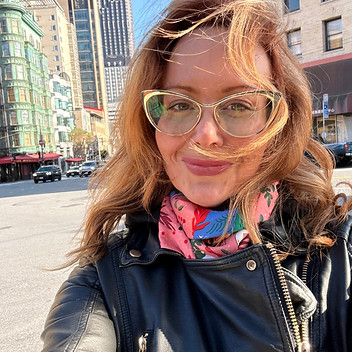
Katie McCleary
Organizer at TEDxFolsomPrison
TEDx Organizer
Sacramento, California, United StatesAbout Katie
I am a…
Artist, Business leader, Change agent, Idea generator, Life mentor, Parent, Performer, Philanthropist, Social entrepreneur, Writer/Editor
Bio
Katie McCleary has spent 25 years inside the most consequential conversations of her career, and none of them happened in a boardroom.
Some happened in a California state prison, sitting across from men and women who had been told their voice didn’t matter. Some happened in classrooms where kids who’d never seen themselves as writers filled a page and discovered that language could be something they owned. Some happened onstage, in front of thousands of people who left with a completely different understanding of how they communicate and connect.
What Katie does is help people find the human tools hiding in plain sight. Tools like curiosity. Like the willingness to be known, and to genuinely know someone else. She calls this conscious communication. And it changes everything.
Katie is a TED speaker and two-time TEDx speaker with more than 4 million views. She co-authored Bridge the Gap (McGraw Hill), named one of Inc. Magazine’s Top 3 Business Books of 2022 and endorsed by Dr. Amy Edmondson and Daniel Pink. She founded 916 Ink, a youth literacy nonprofit that has transformed 8,000 young people into published authors. She holds a Master’s degree in Writing and Consciousness, teaches graduate leadership at Pacific University, and hosted NPR CapRadio’s The Drive.
Her work has been recognized by Mashable, PBS KVIE, Forbes, Inc., The Wall Street Journal, and more than 100 media outlets. She was named one of 100 Women to KNOW in America for 2026. She works globally through Paper Wings Creative Consulting.
The most powerful tools are not the newest ones. They are the human ones, hiding in plain sight.
I'm passionate about
I am obsessed with what happens inside the human mind when it finally gets out of its own way.
Meta-cognition is the throughline of everything I do. Not just what we think, but how we think, what patterns we default to, what assumptions we carry without examining them. When I teach it, I am not teaching people to think harder. I am teaching them to think differently about their own thinking. That shift, held long enough, changes people.
Curiosity is not a personality trait. It is a skill. Organizations without it calcify. Leaders without it stop growing and start defending. Genuine curiosity requires the courage to not know, to sit with uncertainty long enough for something new to emerge. That is countercultural work in a world that rewards certainty and speed. It is also some of the most important work I know how to do.
Literacy is where my passion becomes personal. When I founded 916 Ink, I believed every young person had a story worth telling. What I discovered was that giving someone the tools to tell their story produces not just a book but a person who understands their inner life has value. I have watched that transformation more than 8,000 times, in kids who never imagined themselves as authors and in incarcerated people who wrote their way back to themselves one sentence at a time.
I do not believe in throwaway people. My work inside California’s correctional system is among the most formative of my career. The capacity for reflection and genuine transformation does not disappear inside a cell. It waits. It needs a prompt, a pen, seven minutes, and someone who believes it is still there. Prison reimagination is not a policy conversation for me. It is a deeply human one.
Birds are descendants of dinosaurs who survived a mass extinction by evolving, not by being the biggest or most powerful, but by developing new capacities for a world that had changed. I think about this constantly. Milo, my 11-year-old Eclectus parrot, is my daily reminder that wisdom does not always arrive in the forms we expect. The hero line of my work is Together We Fly. It is not a tagline. It is a philosophy.
What is possible when we stop settling for what has always been? That question animates everything I do. The most powerful tools are not the newest ones. They are the human ones, hiding in plain sight, waiting to be picked up again.
An idea worth spreading
We have optimized nearly everything for speed. We type, dictate, copy, paste, and swipe our way through our lives without asking what we might be losing in the transaction.
What we are losing is quite a lot.
Writing by hand is not a relic. It is one of the most powerful cognitive tools available to human beings, and we have largely abandoned it at the precise moment in history when we need it most. When we write by hand, we engage the brain differently than when we type. The physical act of forming letters activates neural pathways associated with learning, memory, and emotional processing. Researchers at Princeton and UCLA found that students who took notes by hand outperformed those who typed, not because they captured more words, but because they were forced to synthesize in real time. The slowness was the point. Typing transcribes thought. Handwriting transforms it.
At the center of Katie’s work is a deceptively simple methodology: a prompt, seven minutes, and a set of rules. Write in your mother tongue. Write the language closest to your body, before you perform yourself for anyone. Keep the pen moving. Do not edit. Let go, and see what bubbles up. What bubbles up is almost always the thing that matters most.
Katie has used this methodology in boardrooms and correctional facilities, with executives who haven’t picked up a pen in years and with young people who were never told their thoughts were worth writing down. In every setting, the same thing happens. The hand moves. The mind follows. Something arrives on the page that was not accessible a moment before.
This idea is not anti-technology. It is pro-human. The invitation is not to abandon your keyboard. It is to add back something you may have quietly let go. Seven minutes. A prompt. Your own true voice. Write it down by hand. See what bubbles up.
The TED story
When I walked onto the TEDx stage in Eustis, Florida, I knew I was about to say something the audience would instinctively resist. I was going to tell a digitally fluent, productivity-obsessed room to put down their devices and pick up a pen, not as a wellness exercise but as a serious argument backed by neuroscience and 25 years of professional experience.
The handwriting talk felt different from any I had given before because it was personal. Writing by hand is how I process the hard things. It is how I find the edges of my own thinking and locate what I actually believe underneath what I am supposed to believe. It is one of the most honest relationships I have. And I had watched it do the same for others, for young people at 916 Ink who filled pages and discovered their voice mattered, and for incarcerated men and women inside California correctional facilities who wrote their way back to themselves.
That convergence of lived experience and hard science became the talk. What I brought to the stage was not just an argument but a practice: a prompt, seven minutes, a set of rules. Write in your mother tongue. Keep the pen moving. Let go and see what bubbles up.
I have stepped onto three TEDx stages. Eustis. Gainesville. The University of Grand Canyon, where I shared the stage with my co-author Jennifer Edwards, my polar opposite in nearly every way and the living proof of concept behind Bridge the Gap. Across those three talks, the views have grown to more than four million, roughly 1.4 million each.
What that number represents is not a metric. It is a measure of how many people were quietly waiting for permission to slow down, to reconnect with their own minds, to reclaim a practice that no app or platform can replicate.
Things you might not know
Talking to Animals
Reading Tarot