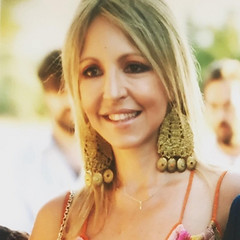
Fiori Zafeiropoulou Fronimopoulou
Social entrepreneur, researcher and builder of the Factory of the Future at SOFFA, Fashion Revolution, Athens University of Economics & Business
TED Attendee
Athens, GreeceAbout Fiori
I am a…
Activist, Care taker, Educator/Teacher, Environmentalist, Global soul, Idea generator, Scientist, Social entrepreneur, World traveler, Writer/Editor
Bio
Dr. Fiori A. Zafeiropoulou Fronimopoulou is a Greek social entrepreneur, researcher and global advocate working to transform fashion from one of the world’s most extractive industries into a force for dignity, regeneration and local prosperity.
She is the founder and president of SOFFA – the Social Fashion Factory in Athens, Country Coordinator of Fashion Revolution Greece, and a postdoctoral researcher at the Athens University of Economics and Business, where she explores how ethical, green and digitally enabled manufacturing can return to the city. Her work sits at the intersection of social justice, industrial renewal and cultural imagination: from supporting women survivors of trafficking and violence through co-creation, training and work integration, to rebuilding local textile and footwear ecosystems through circular design, traceability, education and AI-enabled production.
Fiori holds a PhD in Social Entrepreneurship and Innovation from Brunel Business School and has spent nearly two decades building bridges across academia, activism, policy and industry. She has led or helped secure major European initiatives focused on circular fashion, transparency, reskilling, urban manufacturing and digital transformation, while founding ventures and platforms such as Wear Your Origins, the Fashion Revolution Summer School, the Raise Your Voice Festival against human trafficking, and the relaunch of ZITA Hellas as part of a wider vision for a new Sneaker Factory of the Future in Europe. She also serves in Fashion Revolution’s global governance transition, helping shape the movement’s evolution toward a truly global structure.
Her work asks a deceptively simple question: what if the factory of the future were not hidden at the edge of the world, but returned to the heart of the city as a place of beauty, authorship, repair, learning and community? For Fiori, this is not nostalgia. It is a new operating system for local resilience — one in which AI supports human creativity rather than replacing it, waste becomes raw material for rebirth, and the people behind our clothes are no longer invisible.
She has spoken at TEDx stages and international platforms including the EU Climate Pact, the New European Bauhaus Festival and European Commission forums, and has been featured by media such as Reuters, BBC, VICE, Vogue and Elle. Whether in a classroom, a policy room, a workshop floor or on a stage, Fiori works to make one thing visible: the future of manufacturing is not only technical. It is moral, cultural and profoundly human.
I'm passionate about
I am passionate about places where the invisible becomes visible.
The invisible woman behind a garment.
The invisible violence hidden inside a supply chain.
The invisible beauty inside textile waste.
The invisible knowledge carried by artisans, migrants, mothers, makers and survivors.
The invisible future sleeping inside abandoned industrial buildings.
I am passionate about building systems where these hidden worlds can meet.
This is why I care so deeply about fashion. Fashion is never only about clothes. It is about labor, desire, storytelling, identity, trade, status, land, water, waste, memory and power. It is one of the clearest mirrors of how a society organizes value. If we can transform fashion, we can also transform the underlying assumptions of our economy.
I am especially passionate about the empowerment of women who have survived violence, trafficking and displacement — not through pity, but through authorship, income, visibility and agency. I do not believe the opposite of exploitation is merely employment. I believe the opposite of exploitation is the restoration of voice, choice and creative power.
I am also passionate about re-localizing production in Europe and beyond through regenerative, circular and digitally enabled manufacturing. Right now I am especially energized by the convergence of AI, circular design, education, advanced manufacturing, living labs and heritage industrial renewal. I believe we are at a civilizational threshold: either technology deepens distance and disposability, or it helps us recover relationship, stewardship and belonging.
On a deeper level, I am passionate about the unity of seemingly separate worlds: ancient wisdom and future industry, philosophy and engineering, beauty and policy, ethics and entrepreneurship, local craft and planetary responsibility. My work is driven by a belief that real innovation is transformation.
An idea worth spreading
We have spent decades designing factories as if they should be far away from us — hidden from our cities, our imaginations and our consciences. That distance did two things at once: it made waste easier to normalize and exploitation easier to ignore.
My idea is that, in the age of AI, we have a chance to bring back a completely different kind of factory.
Not the old dirty factory.
Not the opaque factory.
Not the factory that treats people as replaceable hands at the end of a chain.
I am speaking about a Factory Next Door: a transparent, beautiful, circular, urban place where design, production, repair, education and community coexist. A place where AI helps remove repetition and supports human imagination. A place where materials can be remade, where labels carry stories, where local people can see how things are made, and where the maker returns to the center of value.
This matters to fashion, but it also matters far beyond fashion. Because when a city can no longer make what it needs, it becomes fragile. Local making is not nostalgia; it is resilience. It is climate action, social justice, cultural memory and democratic participation woven together.
I have seen this firsthand through work with women survivors of trafficking and forced displacement, through circular manufacturing experiments in Athens, and through trying to relaunch my own family’s historic Greek sneaker brand, ZITA Hellas. These experiences taught me that the future is not about resurrecting the past exactly as it was. It is about designing a new industrial culture in which heritage meets a new operating system.
My idea worth spreading is this:
AI can help us make again — but only if we use it to make work more human, cities more alive, and value more visible.
Areas of expertise
anti-trafficking in fashion, ethical supply chains, factory of the future / future of manufacturing, movement building, multi-stakeholder consortium development, Regenerative fashion systems, social entrepreneurship, sustainable fashion, urban industrial revival, women’s empowerment
The TED story
My TED story begins in the afterlife of a factory.
I grew up with the memory of manufacturing before I had the language for systems change. My family was part of Greece’s footwear industry, and ZITA Hellas — the sneaker factory built by my father and uncle — once represented a world in which things were still made close to home. Then, like so much of European manufacturing, that world disappeared. Production moved away. Skills scattered. Buildings remained, but the ecosystem was gone.
For a long time, I thought I was mourning a family story. Later I understood I was witnessing a civilizational story: the separation of production from place, of value from maker, of consumption from consequence.
Years later, while working with women survivors of trafficking, violence and forced displacement, I encountered the same hidden logic from another angle. The people who make our clothes were invisible. Their pain was invisible. Their talent was invisible too. I began asking a question that would change my life: what if fashion could become a place not of erasure, but of authorship?
That question led to SOFFA, to Wear Your Origins, to anti-trafficking advocacy, to Fashion Revolution Greece, to research, to education, to circular manufacturing experiments, and eventually back to the factory itself.
But when I returned to the idea of the factory, I no longer wanted to bring back the past as it was. I wanted to reinvent it.
What if a factory could be transparent?
What if it could be local, beautiful and open to the community?
What if waste could bloom into new products?
What if AI could support human creativity instead of displacing it?
What if the hidden people behind our clothes became recognized authors of value?
What if making returned to the city not as pollution, but as culture?
That is the TED story I want to tell. It is personal, political, industrial and deeply human all at once. It begins with loss, moves through witnessing, and arrives at a proposition: the future factory can become one of the most hopeful civic institutions of the 21st century.
Because the real question is no longer whether we will automate.
The real question is: what kind of society are we designing when we do?
Things you might not know
People often know me as a speaker, researcher, founder or activist. What they usually don’t know is that one of my strongest skills is building improbable constellations of people who would not normally work together and helping them create something meaningful.
I am very good at standing at the threshold between different languages and translating across them:
between academia and the factory floor,
between policymakers and makers,
between survivors and designers,
between cultural heritage and industrial innovation,
between visionary ideas and operational ecosystems.
I am good at sensing patterns before they are obvious. I often see not just a project, but the ecology a project will require in order to live. This is why so much of my work has focused not only on creating products or programs, but on building platforms, hubs, curricula, communities and partnerships that make new futures possible.
I am also good at making complexity feel human. I can take something structural — circular supply chains, urban manufacturing, anti-trafficking policy, AI-enabled production, systems theory — and translate it into a story people can feel, remember and act on.
And perhaps because I have lived across so many worlds, I am good at holding vision during uncertainty. I know how to stay with an idea through failure, pause, reinvention and return. The relaunch of ZITA taught me that. So did SOFFA. So did my academic journey. So did every room in which I had to ask people to believe that what looked fragmented could still become whole.