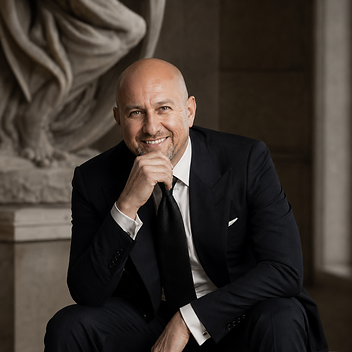
Marvin V Acuna
Organizer + Producer at TEDxBeverlyGrove
TEDx Organizer
Los Angeles, California, United StatesAbout Marvin V
I am a…
Artist, Athlete, Blogger, Brainstormer, Business adviser, Business leader, Business mentor, Change agent, Connector, Consultant, Entrepreneur, Filmmaker, Foodie, Global soul, Idea generator, Inventor, Investor, Life mentor, Marketer, Philanthropist, Producer, Promoter, Sales specialist, World traveler, Writer/Editor
Bio
Marvin V. Acuna works where experience becomes intellectual capital.
He works with founders, CEOs, entrepreneurs, experts, and industry leaders to uncover the ideas buried inside years of experience and give those ideas the clarity, structure, and language required to travel.
Through Intellectual Capital Architecture, Marvin helps transform lived experience and expertise into intellectual assets, from category-defining ideas and keynote platforms to TEDx talks, books, thought leadership, advisory businesses, strategic partnerships, and other vehicles capable of extending an idea beyond the person who first discovered it.
His work begins with a simple observation: accomplished people often spend decades building companies, careers, and expertise without intentionally building the intellectual capital those experiences contain.
Marvin's role is to help identify what is worth preserving, clarify what is worth saying, and architect the structure capable of carrying it forward.
As a TEDx Organizer and Producer, he also builds stages for ideas and works closely with speakers to develop talks worthy of the room in which they are first heard.
The common thread across his work is a belief that experience alone does not become wisdom, and wisdom alone does not become influence. Both require architecture.
Commercializing Wisdom.
Through Intellectual Capital Architecture.
I'm passionate about
I am drawn to anything that helps me understand the world a little more clearly.
Books do that. They let you borrow the hard-won wisdom of people who made mistakes before you had the chance to make them yourself. Reading, at its best, is not escape. It is leverage. It lets you travel through history, strategy, failure, faith, invention, and human nature without needing to learn every lesson the expensive way.
Food does something similar.
I love food, but more than that, I love the craft of food. I think chefs are the new rock stars. The difference is that you do not have to stand in a stadium with 20,000 people to experience what they have made. You can sit at a table, take a bite, and listen for the story they are trying to tell.
Food tells you where you are in the world. Sometimes it takes you somewhere else entirely. A dish can move you across a border, into another culture, or back into a room you thought you had forgotten. It can return you to someone you love, or someone you loved. In that sense, food is one of the most underrated time machines we have.
Travel expands that feeling.
The more I see of the world, the smaller and more connected I feel. Travel reminds me that I am a speck of dust standing on the shoulders of people who sacrificed, built, fought, loved, failed, and endured so that the rest of us could inherit something larger than ourselves.
It also reminds me that people are not nearly as different as we are sometimes told. Across countries, languages, and customs, the deepest things tend to rhyme: God or purpose. Family. Friendship. Love. The desire to matter. The need to belong.
And finally, I am passionate about who I am becoming.
That may be the real subject beneath all the others. Learning, food, travel, faith, relationships, ambition, discipline. They are all part of the same inquiry: how do we become more fully what we were created to be?
I believe we are always changing. The question is whether we are changing by accident or by intention.
I am interested in the intentional kind.
An idea worth spreading
A Reader’s Guide to Stories Designed to Shape Perception
Most people know when a story feels wrong. They just cannot always explain why.
That is often the point.
Some narratives are not built to reveal what happened. They are built to create a feeling about what happened. They depend on readers moving quickly enough to absorb the conclusion before noticing how it was assembled.
The trick usually happens in plain sight. A claim appears early. A source disappears behind anonymity. A fact is stripped of its companion. Two details are placed close enough together that the reader supplies the accusation the writer never quite makes.
By the end, the story may contain accurate pieces. But the architecture is doing something else.
Here are six patterns worth noticing.
1. The conclusion arrives before the evidence.
Watch the opening. Is the central claim attributed to anyone? Is it sourced to anything? Or does it simply appear, fully formed, as if everyone already knows it to be true?
In a story built around discovery, the conclusion emerges from the reporting. In a story built around a premise, the reporting is arranged to support the conclusion.
One is journalism. The other is argument wearing journalism’s clothes.
2. The anonymous source becomes the load-bearing wall.
Anonymous sourcing has a legitimate purpose. It protects people who face real consequences for telling the truth.
But anonymity can also protect the claim.
The question is simple: What would this person risk by saying this publicly?
If the risk is real, anonymity may be justified. If the risk is vague or nonexistent, it may be shielding an accusation from scrutiny.
A story where every damaging characterization comes from unnamed people deserves a second read.
3. The named sources complicate the story.
Named sources carry accountability. They can be contacted, questioned, challenged, and corrected.
So when named sources complicate the central premise, notice what happens next.
Does the story adjust? Or does it acknowledge the complication and keep moving?
That is where the structure becomes visible. The evidence is not leading the story. The story is leading the evidence.
4. The omitted context has a direction.
Every story leaves things out. It has to. The question is whether the omissions all lean the same way.
A venue is described by what it is near, rather than by what it is. Empty seats are counted without explaining what occupied the others. A dispute is introduced without the resolution that followed.
The individual facts may be accurate. The overall design may still mislead.
That is not always fabrication. Often, it is curation with intent.
5. Juxtaposition does the accusing.
The most efficient form of narrative persuasion requires no explicit accusation.
It places two things next to each other and lets the reader draw the line.
A person. A fact. A controversy. A location. A prior dispute.
The writer never has to defend a claim that was never quite made.
Watch for the moment a story shifts subjects without explaining why. That shift may be the argument.
6. Ask who benefits from the story existing.
Stories rarely appear from nowhere.
A reporter may write the story. An editor may approve it. But before that, someone often pointed the light.
Someone made a call. Someone framed the subject. Someone decided that this person, institution, or event deserved attention at this moment, in this way.
The useful question is not always, “Who wrote this?”
The better question may be: Who benefits from this story existing?
You may not be able to answer it. That is fine. The question still does its work. It reminds the reader that stories have origins, incentives, and beneficiaries.
None of this requires cynicism.
Cynicism assumes bad faith before reading. Attention does something better. It notices structure.
A predetermined narrative is built for speed. It depends on the reader moving quickly from impression to conclusion. It is much less durable when the reader pauses.
The next time a story feels wrong, do not dismiss the feeling. Interrogate it.
Ask where the conclusion first appeared. Ask who is named and who is hidden. Ask what context is missing. Ask whether the story argued its case or merely arranged its pieces so you would argue it for them.
The answer is usually visible.
It was simply waiting for someone to look.
Areas of expertise
Leadership Development • Executive Communication • Strategic Planning • Systems Thinking • Narrative Strategy • Talk Architecture • Executive Coaching • Performance Under Pressure
The TED story
I first came to TED brokenhearted.
I was sitting alone in a dimly lit room, watching a talk by Brené Brown. I had never heard of her. I had not read her books. I could not have quoted her research. I am not even sure, now, which studies she referenced.
But I remember one sentence.
“Vulnerability is not weakness; it’s our greatest measure of courage.”
That sentence found the part of me that had been trained to hide.
I grew up in a Latino household shaped by a strong, male-dominant culture. In my world, men did not reveal much. I saw my father cry only twice. The first time, I thought he was having a heart attack. The second time, he was near the end of his life.
So I had absorbed a lesson I did not know I had absorbed: to be open was to be weak. To be wounded was to conceal it. To feel deeply was one thing. To show it was another.
Then one idea broke through.
It did not sound dramatic at first. It was not shouted. It was not wrapped in spectacle. It was just an idea, clearly stated, by a person who had done the work to earn it.
And it changed the architecture of my life.
For the first time, I understood that vulnerability was not the opposite of strength. It was one of its most honest forms. That realization loosened something in me. It gave me permission to name my sadness, to express it, and eventually to release it.
That was the moment I understood what TED could do.
I had always believed ideas moved people. But this idea moved me. Not intellectually. Personally. It reached past my defenses and rearranged what I believed about courage, shame, grief, and healing.
I knew then that I wanted to be part of this world.
Years later, after producing a TEDx event, that belief has only deepened. There is a particular feeling that comes from building a room where serious ideas can land. It is not entertainment. It is not performance for its own sake. At its best, it is a transfer of courage from one person to another.
One of the most meaningful moments for me was inviting six system-impacted foster youth to attend. Watching them sit in that room, take in the talks, and feel the possibility of a larger world reminded me why this work matters.
Ideas move people.
Sometimes they move them across a room.
Sometimes they move them across a life.
TED did that for me. TEDx allows me to help create that possibility for others.
People don't know I'm good at
People are often surprised by the things I am quietly good at.
Chess, for one. Movie trivia, for another. I like games where memory matters, but pattern recognition matters more.
I am also unusually good at building food itineraries in almost any city I visit. Not the obvious list. The better list. The place for the first bite. The place for the long lunch. The place you walk to afterward because the neighborhood has something to say. I think a good food crawl is really a story disguised as a schedule.
Food has always been part of how I understand the world. I once took a master class with James Suckling because I wanted to get better at choosing wine. Not to sound impressive at dinner. To understand what I was tasting, and why it mattered.
I learned to make cakes with my mother when I was thirteen because I was her translator in class. At the time, I thought I was helping her understand the instructor. Looking back, I realize she was teaching me something else entirely: how love can be measured in flour, patience, and repetition.
I have also taken a stand-up comedy class, an improv class, and a voice class. I am drawn to anything that teaches you how people listen, where they laugh, when they lean in, and what makes a room change temperature.
And, finally, I cry every single time I watch Undercover Boss.
Every time.
There is something about watching ordinary people be seen for what they carry quietly that gets me. Maybe that is the thread running through all of it: chess, food, film, wine, comedy, voice, cake, travel. I am interested in the hidden structure beneath the visible thing.
The move behind the move.
The story behind the meal.
The person behind the performance.