About Naseer
I am a…
Activist, Educator/Teacher, Entrepreneur, Environmentalist, Finance professional, Inventor, Muslim, Social entrepreneur, Student, Technologist
Bio
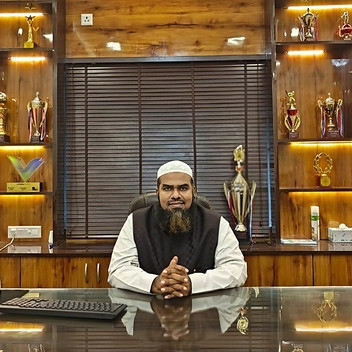
Naseer Ali is an educationist and entrepreneur based in Kalaburagi, with over 16 years of experience in transforming learning environments. He is the Director of Mount Litera Zee School Kalaburagi and the founder of Caliph Degree College and Asila Degree College.
Starting his journey in 2008 with a focus on computer hardware and networking training, Naseer has consistently worked at the grassroots level to bridge the gap between education and real-world skills. His leadership is defined by a strong belief that schools must go beyond textbooks to prepare students for life.
Under his direction, Mount Litera Zee School Kalaburagi has emerged as a center for innovation, integrating initiatives such as robotics labs, entrepreneurship programs, and a collaboration with IIT Madras through the School Connect Program.
An alumnus of Gulbarga University and the Education Leadership Program at IIM Calcutta, Naseer is known for his calm, people-first leadership and his commitment to building future-ready learners. His work focuses on rethinking how schools can nurture curiosity, responsibility, and problem-solving in students.
I'm passionate about
I’m passionate about transforming education into a meaningful, real-world experience where students don’t just learn concepts but develop the ability to think, create, and solve problems.
An idea worth spreading
Idea Worth Spreading
“Schools must shift from creating job seekers to developing problem solvers and value creators.”
For decades, education has been designed around one central outcome—helping students secure jobs. Marks, ranks, and degrees have become the primary measures of success. But the world our students are stepping into today is fundamentally different. With rapid technological advancement, especially in artificial intelligence, information is no longer scarce. What is scarce—and valuable—is the ability to think, create, and solve real problems.
Yet, most classrooms still reward memorization over curiosity, and compliance over creativity.
The real question we must ask is: Are we preparing students for exams, or for life?
A student who can reproduce answers may score well, but a student who can identify problems, think critically, and build solutions will thrive in any environment. The future belongs not to those who know the most, but to those who can apply what they know in meaningful ways.
This shift requires a fundamental rethinking of how schools function.
Students should not just learn concepts—they should experience them. They should build, experiment, fail, and try again. When a student creates a product, understands its value, markets it, and learns from failure, education becomes real. It moves from theory to transformation.
Entrepreneurship, in this sense, is not about starting companies. It is about developing a mindset—the ability to take initiative, solve problems, and create value in any field.
Equally important is the role of educators. Teachers are no longer just providers of information; they are facilitators of thinking. Schools must create environments where questioning is encouraged, ideas are explored, and learning is connected to real-world contexts.
If we continue with the current system, we risk producing students who are well-qualified on paper but unprepared for reality. But if we make this shift, we can nurture a generation that is confident, capable, and future-ready.
Education must evolve from a system that produces job seekers to one that develops problem solvers and value creators—individuals who don’t just adapt to the future, but actively shape it.
The TED story
My TED Story – Naseer Ali
My journey in education did not begin with a grand vision—it began with a simple intention: to make learning more meaningful.
In 2008, I started working in the field of computer hardware and networking training. I interacted closely with young people who had completed their education but lacked the confidence and practical skills needed for the real world. That experience stayed with me. It made me question a system where students spend years studying, yet struggle when it comes to applying what they have learned.
This question became the foundation of my journey.
As I moved into building and leading educational institutions, including Mount Litera Zee School Kalaburagi, I carried this concern with me: how can we make education more real, more relevant, and more impactful?
I realized that the problem was not with students—it was with the way we define learning. We were preparing students to perform in exams, but not necessarily to face life.
This led me to experiment with new approaches. We began introducing experiential learning—creating spaces where students could build, create, and think. Initiatives like robotics labs and entrepreneurship programs were not just activities; they were attempts to shift the mindset from passive learning to active problem-solving.
One of the most powerful moments for me was watching students create their own products—from idea to execution—and understand concepts like value, pricing, and responsibility. In that moment, learning became real. It was no longer about marks; it was about meaning.
My journey further evolved when I had the opportunity to learn from some of the finest minds in education at IIM Calcutta. It reinforced my belief that education must continuously evolve to stay relevant to the world students are entering.
Today, I strongly believe that schools must move beyond their traditional role. They must become environments where students are encouraged to question, to fail, to build, and to grow.
Because the goal of education is not just to prepare students for their first job—it is to prepare them for life.
And that is the journey I continue to work on every single day.
People don't know I'm good at
People don’t know I’m good at taking simple ideas and building them into meaningful, real-world impact through consistent, ground-level effort.