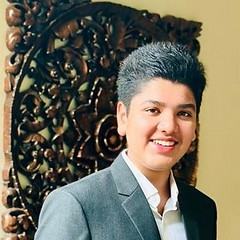
About Youvvraj
I am a…
Student
Bio
Youvvraj Kothawala is a passionate leader with a deep interest in engineering, economics, and event management. His journey with TEDx began as a volunteer, where he was fascinated by the energy and impact of the event. The following year, he joined the core team as the Marketing Head, mastering the art of storytelling, audience engagement, and strategic outreach. His dedication and leadership led him to become the President and License Holder of TEDx in 2024, where he took charge of sponsorship pitching, financial planning, venue management, and overall event execution.
Beyond TEDx, Youvvraj is an aspiring engineer with a strong analytical mindset, combining technical problem-solving with economic insights. His passion for STEM and economics drives him to explore how technological advancements can be implemented sustainably in global markets. An experienced public speaker and strategist, he thrives in dynamic environments where innovation meets execution.
In addition to academics and leadership roles, Youvvraj is a skilled swimmer, writer, and drummer, showcasing his versatility and dedication across multiple fields. With a keen interest in networking, mentorship, and hands-on learning, he continues to seek challenges that push him beyond his limits, shaping him into a well-rounded and impactful leader.
I'm passionate about
Engineering and economics are two fields that, when combined, offer a powerful lens through which to solve real-world challenges. My passion for both stems from their ability to shape societies, drive innovation, and optimize resources for efficiency and sustainability. Engineering, at its core, is about problem-solving and creation—designing machines, structures, and systems that enhance human life. Whether it’s mechanical engineering refining manufacturing processes or electrical engineering advancing renewable energy, this field pushes the boundaries of what is possible. On the other hand, economics provides the framework for understanding how these advancements integrate into markets, impact industries, and influence global development. The intersection of STEM and economics is particularly exciting because technological progress is only as impactful as its implementation within economic systems. For example, electric vehicles are a revolutionary engineering feat, but their widespread adoption depends on factors like cost-benefit analysis, government incentives, and supply chain optimization.
One of the most fascinating aspects of engineering is its tangible impact on society—innovations in robotics, automation, and sustainable infrastructure are transforming industries at an unprecedented pace. However, without economic insight, even the most groundbreaking technology may fail to achieve its full potential. Economics helps quantify the feasibility, scalability, and accessibility of engineering advancements, ensuring that solutions are not just theoretically brilliant but also viable in the real world. Take renewable energy as an example: engineers develop solar panels with increasing efficiency, but the economic principles of supply and demand, subsidies, and investment decisions determine their actual deployment. Similarly, artificial intelligence is revolutionizing industries from healthcare to finance, but its economic implications—job displacement, ethical concerns, and productivity shifts—must be carefully analyzed to harness its benefits while mitigating risks.
Beyond their theoretical applications, both fields share an analytical foundation. Engineering relies on mathematical modeling, physics, and computational simulations to design and test solutions, while economics applies statistical models, optimization techniques, and data analysis to understand market trends and policy impacts. This blend of logic, creativity, and practical application makes the intersection of STEM and economics a thrilling space for innovation. Whether designing energy-efficient machinery, optimizing logistics for global trade, or contributing to economic policies that promote technological growth, the ability to bridge both disciplines allows for well-rounded, impactful decision-making. My passion for engineering fuels my desire to innovate, while economics provides the strategic perspective needed to implement those innovations effectively. Together, they create a pathway toward a future where technology not only advances but does so in a way that is economically viable, sustainable, and beneficial for society.
An idea worth spreading
Radical reforms is an idea worth spreading because it challenges the status quo and drive meaningful societal change. Throughout history, transformative shifts—whether in governance, technology, education, or human rights—have redefined the way we live and think. Unlike incremental changes, radical reforms address deep-seated issues at their core, offering bold solutions to systemic problems. From the abolition of slavery to the rise of renewable energy and artificial intelligence-driven healthcare, radical reforms have reshaped economies, democracies, and individual lives. In an era marked by pressing challenges—climate change, wealth inequality, and ethical dilemmas surrounding technology—our ability to embrace and implement radical reforms will determine our collective future. The resistance to such reforms often stems from fear, tradition, or economic interests, yet history has proven that societies thrive when they dare to innovate. Moreover, radical reforms are not just about grand political revolutions; they also manifest in shifts in thought, culture, and everyday life. For instance, the digital revolution drastically altered communication, breaking barriers to information and connectivity. Similarly, movements advocating for mental health awareness or gender equality have reshaped institutions and workplace cultures worldwide. By discussing radical reforms in a TEDx setting, we encourage audiences to rethink what is possible, question outdated norms, and engage in conversations about bold solutions. The talk can spark new ideas, inspire grassroots activism, and equip individuals with the mindset to be catalysts of change within their own fields. Additionally, radical reforms require collaboration across disciplines—scientists, policymakers, and entrepreneurs must work together to implement sustainable and ethical solutions. This cross-sectoral dialogue fosters innovation and ensures reforms are not only visionary but also practical and impactful. The idea is worth spreading because, at its core, radical reform is about progress—it is about recognizing when evolution is necessary and having the courage to pursue it, even in the face of uncertainty. Whether through technological breakthroughs, policy overhauls, or shifts in social consciousness, radical reforms hold the potential to redefine our world for the better. A TEDx talk on this topic would ignite discussions on how to navigate and implement these changes, ultimately empowering audiences to be agents of transformation.
Areas of expertise
Economics, Mathematics, Physics
The TED story
A few years ago, I walked into a TEDx event, not as a speaker, not as a core team member—just a volunteer. My job was simple: help with logistics, guide guests, and ensure the event ran smoothly. I was just another face in the crowd, absorbing the energy, watching ideas spark conversations, and witnessing people leave inspired. But something about being part of that event struck me. TEDx wasn’t just about speakers on a stage—it was about an ecosystem of passionate individuals working together to bring an idea to life. And I knew, right then, that I didn’t just want to stand on the sidelines. I wanted to be in the core team, shaping the experience.
The following year, that vision became reality. I became a core team member and was entrusted with leading marketing. Suddenly, my role wasn’t just about being present—it was about crafting a narrative, drawing people into the event, and making them believe in the power of the ideas we were sharing. I learned how to strategize social media campaigns, collaborate with designers, and build an audience from scratch. But more than that, I learned the power of persuasion—how to get people excited about something they had never experienced before. And somewhere in that whirlwind of content, analytics, and audience engagement, I realized something: marketing wasn’t just about selling an event. It was about storytelling. And what better way to shape a story than to be at the heart of it?
That’s when I set my eyes on something bigger. The role of the organizer—the president. The one who brings it all together. The one who ensures that every aspect, from securing a venue to curating speakers, from pitching to sponsors to managing finances, fits into a seamless vision. The one who holds the license, making the event official. That role fascinated me. It felt like the ultimate challenge. And so, I worked for it.
In 2024, my school believed I was worthy of it. They handed me the responsibility to lead the entire TEDx event as the event president and license holder. It wasn’t just an achievement; it was an opportunity to test everything I had learned. And let me tell you—nothing prepares you for the moment when all eyes turn to you for answers. Finalizing the venue? That’s on me. Managing finances? My responsibility. Sponsorship pitches? If I didn’t secure funding, the event wouldn’t happen. Marketing? Still my job, but now layered with the burden of making sure everything else runs perfectly too.
Through this journey, I learned more than I ever could in a classroom. I learned how to negotiate, how to build partnerships, how to handle setbacks without letting them break momentum. I learned that leadership isn’t about having all the answers—it’s about making sure that even when you don’t, the team trusts you to find them. I learned that every great event, every transformative moment, isn’t the result of just one person’s vision, but the collective passion of many.
Standing on that TEDx stage as the president of the event, looking at the audience, the speakers, and my team, I realized something: I had started as a volunteer, fascinated by how things worked. I had stepped into marketing, fascinated by how people connected with ideas. And now, as the organizer, I wasn’t just fascinated—I was building something that fascinated others.
This journey wasn’t just about TEDx. It was about growth. It was about proving to myself that if you dare to step beyond your comfort zone, you don’t just participate in stories—you create them. And maybe, just maybe, you inspire someone else to begin their own.