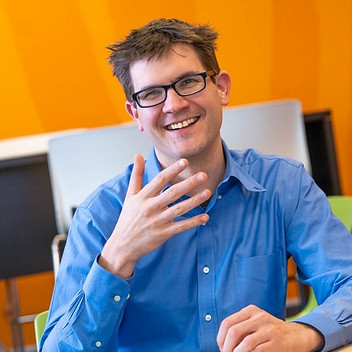
About Adam
I am a…
Athlete, Christian, Engineer, Entrepreneur, Idea generator, Industrialist, Inventor, Investor, Life mentor, Parent, Philanthropist, Real estate professional, Scientist, Social entrepreneur, Startup, Technologist, World traveler, Writer/Editor
Bio
Adam Munder is a strategic leader in AI-driven accessibility solutions, specializing in real-time sign language translation. As a Co-founder of OmniBridge, an Intel Venture, he played a pivotal role in pioneering automated sign language translation technology to bridge communication gaps for Deaf and hard-of-hearing individuals in professional and social settings. Following OmniBridge’s acquisition by Sorenson, Adam continues to lead the strategy for automated sign language translation, working closely with Sorenson’s executive team to advance inclusive AI-powered communication solutions.
With over 14 years of engineering experience at Intel, Adam has led world-class teams of engineers and developers dedicated to inclusivity and accessibility. His expertise spans deep learning, machine learning, applied robotics, mechanical engineering, manufacturing engineering, and nanoscale device systems. He holds an MS in Nanoscale Engineering from SUNY Albany and has multiple publications in lithography and nanotechnology. His passion lies in leveraging cutting-edge technology to break down barriers and create a more inclusive world for the Deaf and hard-of-hearing community.
I'm passionate about
I care deeply about helping people feel understood.
Much of my work sits inside technical fields, but the motivation is personal: communication isolation is one of the most painful human experiences. I’ve watched brilliant, kind, capable people excluded not because of intelligence or ability, but because conversation wasn’t built for them.
I’m passionate about making technology humane — tools that reduce friction instead of replacing connection. AI should not make humans unnecessary. It should make relationships possible.
I’m also passionate about bridging communities that rarely meet: engineers and Deaf users, researchers and families, technologists and educators. Many breakthroughs don’t come from better algorithms; they come from better listening.
Outside of work, I’m passionate about faith, family, and living intentionally. My family lives aboard a sailing catamaran, which constantly reminds me how dependent humans are on cooperation, trust, and clear communication. Sailing is a daily lesson in humility — nature does not care about your plans, only your awareness.
Whether in AI or in life, I believe clarity, honesty, and humility matter more than sophistication.
An idea worth spreading
Accessibility is not a feature — it is a communication infrastructure.
For most of the world, communication is invisible because it works. For Deaf people, communication is something you must actively build every day. What we call “accessibility technology” is actually a preview of the future of human communication for everyone.
AI translation, captioning, and visual communication systems are not only tools for disability support. They are early versions of a new layer of human interaction — one where language, modality, and geography matter less than shared understanding.
The real breakthrough is not that machines can recognize signs or words.
The real breakthrough is that communication is becoming multimodal.
Human beings don’t communicate only with speech. We communicate with expression, movement, timing, context, and intent. Signed languages make this obvious. AI is finally forcing the hearing world to rediscover it.
Deaf communities have spent generations solving communication problems long before Silicon Valley cared about them. If we listen carefully, accessibility will guide the design of future technology — not as accommodation, but as architecture.
When we design systems for the edges of humanity, we improve life for everyone.
The TED story
My journey to TED didn’t start with technology.
It started with communication barriers.
Growing up around Deaf communication shaped how I see the world. I learned early that intelligence and expression are not the same thing, and that society often mistakes silence for lack of understanding. That stayed with me.
Years later, I entered the technology world and saw a different barrier: engineers were building powerful systems, but they were measuring success in ways that didn’t reflect real human experience. Accuracy scores looked impressive, yet real conversations still failed.
So I began working on a question that became my career:
What if technology measured understanding instead of output?
I started a company to explore AI sign language translation, eventually joining a larger organization to scale the work. Along the way, I realized the deeper issue wasn’t just accessibility — it was that modern technology had been designed primarily for one communication style: spoken language.
Signed languages revealed something profound. Communication is visual, emotional, contextual, and relational. Speech is only one form of it.
My TED talk reflects a personal conviction: the Deaf community is not behind the technology curve. In many ways, it is ahead. They have been navigating multimodal communication for generations. AI is simply forcing the rest of the world to catch up.
The future I’m working toward is not a world where machines replace interpreters or relationships.
It is a world where fewer people sit silently in a room unable to participate.
Technology should not just make life efficient.
It should make belonging possible.
People don't know I'm good at
I’m unusually good at translating between worlds.
Not languages — mindsets.
I often work between Deaf users and AI engineers, and the problem is rarely technical. It’s perspective. Each side is intelligent, but they define “success” differently. Engineers look for measurable accuracy. Users look for felt understanding. My role is helping both sides see what the other actually needs.
I’m also good at identifying the real problem hiding behind the stated problem. In accessibility technology, teams often try to improve recognition accuracy when the actual issue is timing, cognitive load, or conversational flow.
Another hidden skill: I can usually tell within minutes of a demo whether a system will succeed in real life. Not because of code quality, but because of human behavior. Communication systems fail socially long before they fail technically.
And outside of technology — I’m a competent marine systems troubleshooter. Living on a boat teaches fast diagnostics: electrical, mechanical, navigation, and weather interpretation. Debugging a power inverter at sea and debugging an AI model feel surprisingly similar.
Both require calm observation, pattern recognition, and not panicking when things go wrong.