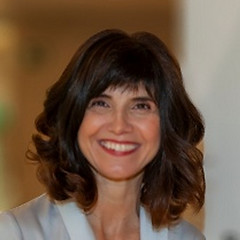
About Idoia
Bio
Idoia Postigo is graduated in Political Sciences (International Relations) and in Psychology. She counts on a Master on Organisational Behaviour.
Extensive education, which includes European and American universities such as the University of Oxford, the London School of Economics in the United Kingdom, and the University of Berkeley (California - USA).
Experience in urban marketing strategies and international communication skills in USA, UK, Latin America, Australia and Asia for nearly years.
She is individual and team coach, as well as mentor of the Law and Economist Associations and collaborator of the Association of Entrepreneur Women “EmakumeEkin”. She counts on a personal blog "Emotionak Fabrika" and is the author of several books in Spanish: two novels and a two technical publication about “Professional and emotional team management”, as well as “Essential Guide for Entrepreneur Women”.
She has been working in Bilbao Metropoli-30 since 1991. As General Director of this organisation, she has been in charge of promoting and disseminating the Revitalisation Plan of Metropolitan Bilbao. Her job has contributed to place BM30 as reference point for the main actors responsible for the urban development of the metropolis, especially public institutions.
I'm passionate about
I am passionate about the power that people have to grow and develop and I am passionate about tracing in myself and in others the causes of our dissatisfactions, which are often directly derived from the way we approach the events of our lives.
People have an innate potential to grow and develop, beyond genetic conditioning, our beliefs and our life experiences.
We cannot decide the things that happen to us, but we can decide how to deal with them. We are free to make our decisions and build ourselves with them every day and, in this protagonism, lies the capacity of people to overcome challenges and achieve objectives.
In this challenge, emotions are an inseparable part of our essence, as emotional beings. Our rational part and our emotional part coexist. Emotions are present in all dimensions of our lives, they affect our experience, influence our performance and guide our behaviour.
The key lies in managing our emotional world, but not repressing it. Awareness of our self-dialogues and the way we tell ourselves about the things that happen to us is of great importance when facing the challenges of our lives.
An idea worth spreading
It is not possible to do away with discomfort. Some degree of malaise is inevitably present in our lives. However, there are socio-cultural influences, largely conveyed by language, through which feeling good, being happy, being optimistic, etc. becomes almost an obligation, commercially encouraged and ostentatiously displayed on our social networks.
Anxiety, fear or stress have an adaptive value. However, the messages that are sent out socially talk about stress management techniques, reducing discomfort, combating anxiety, and so on. We are encouraged to eliminate discomfort, suffering, sadness, etc.; to seek positive emotions that displace our negative affects.
These messages, however, lead us to live more and more trapped in the symbolic world of language and to try to uselessly avoid the causes of our discomfort. It is not the same to tell someone that they should adapt to an adverse situation and seek ways to make it affect them as little as possible as it is to tell them, even implicitly, that it is possible to control it and make it go away. Helping someone to cope with their discomfort is not the same as promising them happiness.
In response, other perspectives have emerged that seek to promote acceptance as a source of healthy emotions and a fulfilling life. Acceptance involves recognising discomfort, negative emotions, unpleasant thoughts, etc. as normal and human. Although feeling sad about a failure or a loss is not pleasant, it is as natural and human an experience as feeling happy after an achievement. Proposing to feel our negative emotions as something natural, without trying to run away from them, allows us to regulate them.
Acceptance does not imply conformity or resignation to the situation. It means not running away from the discomfort so that it does not grow stronger and prevent us from resuming our lives, analysing the factors that have caused our failure and involving ourselves in activities that seek a valuable result for our life goals.
Another fundamental element to increase our acceptance requires deactivating the power of language so that it does not trap us in its literalness. It is necessary to eliminate the fusion between language and reality in order to recover the flexibility that allows us to respond appropriately to the environment in which we live. One way to achieve this is to assume that thoughts are not facts. If I tell myself that this situation is unbearable, I can distance myself from that thought and separate it from reality, assuming that it is simply a perception and, in this way, be able to modulate it.
Another useful tool can be to put our self in perspective. When we say to ourselves "I am clumsy", we are identifying ourselves in a generalised way with being useless. Language has the power to fix and define us in a literal way. However, I can contextualise my thoughts and contextualise myself. I can replace "I am clumsy" with "I am not capable of solving this problem". This reorientation allows us a more genuine acceptance of who we are.
Areas of expertise
coaching, Emotional intelligence, empowerment of women, entrepreneurship, ethics, international relations, strategic thinking, team building
The TED story
The magic of a TED talk is that only a few minutes may change the way you perceive the world and change one’s behaviour forever. A long time ago, I came across Joe Smith “How to use a paper towel” https://www.ted.com/talks/joe_smith_how_to_use_a_paper_towel and I never washed my hands in the same way again. Only 4 minutes of pure joy.
On a different topic, Angelica Dass The beauty of human skin in every color, https://www.ted.com/talks/angelica_dass_the_beauty_of_human_skin_in_every_color is a beautiful argument against racism that I also saw in her project Humanae when it was showed in Bilbao, near to the river. Her talk in TEDxMadrid was beautiful too.
Things you might not know
I think that in general people around me know my abilities. I think I am good at harmonising personal relationships, I am empathetic and able to listen without being interrupted by my ego.
I am also a good organiser. My group of friends always jokes that when I organise excursions, I plan when exactly the fawns are going out.
Another of my hobbies is literature, and specially writing. I find it a totally therapeutic practice to get our thoughts, our fears, our worries out in the open... This side of me is also public.
Perhaps my sense of humour is a more hidden skill. On many occasions, people laugh with me. I am able to connect with the more informal side of people and I find that a great connection.
More secret is my ability to dance. I think I'm a very good dancer.
And I would add as a less public skill that I like to crochet. My grandmother taught me and I find it a very de-stressing practice.