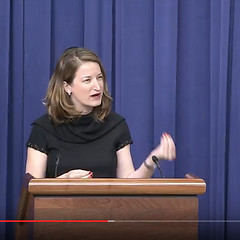
Amy Waterman
Social Psychologist/Professor at UCLA; Terasaki Research Institute
TED Attendee
Los Angeles, California, United StatesAbout Amy
I am a…
Artist, Brainstormer, Business leader, Change Agent, Christian, Educator/Teacher, Entrepreneur, Project manager, Social entrepreneur, World traveler
Bio
I am a Social Psychologist, Professor at University of California Los Angeles (UCLA), and Deputy Director of a Transplant Innovation Institute called the Terasaki Research Institute. In 2016, I spoke at President Obama's Organ Donation Summit at the White House. Kidney transplantation is the best of humanity and the best of healthcare. With over 300 million people in the United States, I believe that the kidney donor shortage can be solved through educating and inspiring more generous people to donate kidneys. Only 100,000 more people need to donate kidneys for the shortage to be entirely eliminated. However, this will take a transformation of communication about organ donation to the general public, dissemination of inspirational stories of people who donated and education, and alignment of healthcare systems to care for all kidney patients and living donors. Black and Hispanic patients are more likely to have kidney failure but less likely to receive transplants, so access to transplant for all needs to be ensured.
My research focuses on how kidney patients and potential living donors make health decisions and whether poor transplant knowledge, fears, or inequities in care limit patients, especially racial/ethnic minorities, from receiving transplants. I also design and test the efficacy of new educational resources, including brochures, videos, and social media campaigns, to motivate kidney patients to receive transplants and living donors to donate. I am also studying the science of storytelling to inspire positive health change. I have received $20 million dollars in federal grants and published almost 100 research articles and book chapters.
In 2009, I founded Explore Transplant, a nonprofit organization to train and equip dialysis providers and nephrology staff to help kidney patients and their families make informed transplant choices. I now partner with a health literacy organization, Health Literacy Media, to create and disseminate transplant education to patients, potential donors, and providers nationally and internationally. We partner with dialysis centers, transplant centers, and Kaiser, in both the US and Canada, to help all patients and donors make informed decisions.
I am passionate about people having the best quality-of-lives possible, especially the patients I serve. It is an honor and a privilege to work in healthcare and learn what the field of kidney transplantation has to teach. Transplant is a metaphor for connectedness and what service to another makes possible. It also is about being vulnerable and receiving help in the most practical way possible. It keeps me centered in what is important – health and service to others – and develops me as a leader, far beyond what I would have done if I didn’t take up this cause. As the world begins to separate behind barriers, organ donation is a reminder of what is possible when all those walls come down.
I'm passionate about
Inventing something that is true and beautiful in the world; Solving the kidney donor shortage; Inspiring people to be kind to one another; Honoring the lessons available through vulnerability and authenticity; Listening; Love; Play and creativity; Photography; Storytelling; Nature.
An idea worth spreading
Organ donation is a reminder that being profoundly connected is necessary to solve important societal problems.
The kidney donor shortage is solvable, in our lifetime, by the generosity of average people. Few health challenges have an obvious solution that is immediately available.
Areas of expertise
academic leadership, behavioral change, disparities, grant writing, health communication, health psychology, living kidney donation, organ donation, social psychology
The TED story
A kidney patient offered to support the costs for me to attend TED to enable me to listen for paradigm-shifting changes possible in my field. I have had the ability to be contributed to by people in the fields of entertainment, health, and technology. I have broadened my view of how organ donation fits into the transformation of our society and its innovations in the last three years. I am a stronger female leader from attending TED and meeting many other male and female leaders that inspire me.
Things you might not know
Enrollment on a national level; remembering what people say years later, finding spelling errors; painting, photography, finding gifts that are so perfect for someone that they cry; getting people's truth; not being intimidated by anyone.