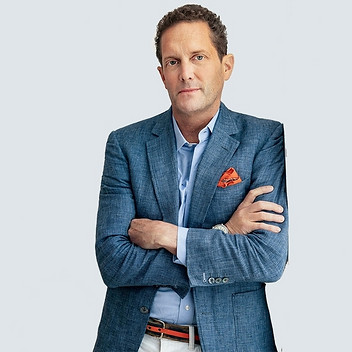
Joshua Abram
Founder at Conceivable & TMRW Life Sciences
TED Attendee
New York, New York, United StatesAbout Joshua
I am a…
Brainstormer, Business leader, Business mentor, Change agent, Concerned citizen, Connector, Entrepreneur, Foodie, Idea generator, Investor, Marketer, Potential employer, Startup, Technologist, World traveler
Bio
Over the past two decades I have been a founder and CEO of a series of venture-backed companies which are recognized as category creators in diverse fields including technology, hospitality, and life sciences. Among these are Integral Ad Science (NASDAQ:IAS), NeueHouse, TMRW Life Sciences and Conceivable Life Sciences. As of December 2021, these firms had a market value of over $5 billion. I was recently named to Goldman Sach's list of "100 Most Intriguing Entrepreneurs."
The primary vehicle for the companies that I start is Coriolis Ventures, of which I am a co-founder. In addition to founding and leading companies, at Coriolis, we are active seed-stage investors with a history of providing the earliest capital to successful startups in diverse industries (eg martech, hospitality and cannabis) that enjoyed exits through acquisitions by such firms as AT&T, Expedia and Greenthumb.
Since 2018, Coriolis has been investing extensively in disruptive technologies in the fertility space, specifically related to the automation of the IVF process. I am the co-founder of TMRW Life Sciences which has raised ~$150M dollars from such leading investors as 5AM, Casdin Capital, Google, Transformation and Peter Thiel to perfect and automate the management of the frozen eggs and embryos which are at the center of almost all IVF procedures today. More recently, I co-founded (and serve as co-CEO) of Conceivable Life Sciences which is creating centralized, autonomous IVF labs aimed at vastly democratizing access to IVF worldwide.
I'm passionate about
In my spare time, reading. These days generally fiction. And for the past two especially, mostly the 19th century cannon, particularly enjoying Austen, Dickens, Tolstoy, etc.
An idea worth spreading
In an equitable and just world, there would be 10-12 million IVF births annually, 10X-12X the present number.
More than 15% of couples trying to conceive learn that they are clinically infertile---essentially unable to have children without IVF. And yet, less than 1% of the world's children (~1 million per year) are born via IVF. This shocking disparity between the number of patients who could benefit from IVF and the number who are able to access it represents a profound inequity which modern medicine can and should address. Meeting the true demand for IVF worldwide would benefit ~20 million adults annually who desperately wish to become parents. The result of meeting this demand would be 10-12 million IVF birth each year to parents who have longed to have children to love and guide.
In awarding the Nobel Prize in 2007 to Robert Edwards, the clinician most associated with the first successful IVF birth, the Nobel committee specifically cited, as part of the importance of Edward's work, a path towards ending the "lifelong trauma" suffered by many who wished to have children but were unable to do so. (Indeed, women informed that they are infertile evidence the same level of the stress marker cortisol as patients told that they have late stage cancer.)
The present IVF ecosystem, especially its outdated labs (manual, analog and largely unchaged in decades) represent an immovable barrier to a democratized IVF. But by introducing proven technology and automation, inspired by a now robust history of lab automation pioneered in cell therapy, we can reduce both the price and time required for parents to undergo IVF by 70% or more, thereby helping to bend the arc of justice towards those for whom being a parent is, in today’s environment, an impossible dream.
Areas of expertise
--Launching catagory creating businesses across multiple sectors--Life Sciences, Martech, Hospitality, IVF innovation
People don't know I'm good at
Ping Pong