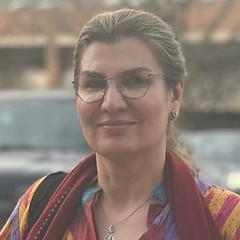
Minhas Majeed Khan, Associate Professor Chair/Deparment of International Relation , UoP
Organizer at Department of International Relations, University of Peshawar
TEDx Organizer
Peshawar, PakistanAbout Minhas Majeed Khan, Associate Professor
I am a…
Educator/Teacher
Bio
Dr. Minhas Majeed Khan is Associate Professor and Chair of the Department of International Relations at University of Peshawar, with a rich academic background and extensive research experience. Holding a Ph.D. in International Relations from Peshawar University, Dr. Khan has further honed her expertise through postdoctoral research at prestigious institutions such as the Institute of Strategic Studies in Islamabad and the CWFL at the Institute for Global Engagement in Washington DC, USA.
With a keen focus on understanding the dynamics of global affairs, Dr. Khan's research interests span a wide array of topics crucial to contemporary international relations. These include religion and politics, countering violent extremism, Islamophobia, Westophobia, the clash of civilizations, foreign policy decision-making, conflict prevention/resolution, US and Pakistan relations, the role of gender in peace and security, as well as regional politics in South, South West, and Central Asia, with a particular emphasis on Afghanistan.
Dr. Khan's specialization lies in exploring the intricate interplay between religion and foreign policy, with a specific focus on US-Pakistan relations. Their expertise also extends to the study of religious extremism, terrorism, Islamophobia, and strategies for countering violent extremism. Furthermore, Dr. Khan has a profound understanding of peace and conflict dynamics, coupled with expertise in peacebuilding and security studies.
With a commitment to academic excellence and a passion for understanding and addressing complex global challenges, Dr. Khan is dedicated to contributing valuable insights to the field of international relations and shaping future generations of scholars and practitioners in the discipline.
I'm passionate about
I’m passionate about exploring how religion, identity, and narrative shape global politics , and how they can be reclaimed as forces for peace rather than conflict. My work focuses on countering violent extremism, dismantling Islamophobia and Westophobia, and promoting inclusive diplomacy rooted in empathy and justice. I believe in the transformative power of ideas, especially when shared across borders, generations, and beliefs. Above all, I’m committed to mentoring youth and amplifying voices that imagine a more peaceful, pluralistic world.
An idea worth spreading
In a world increasingly polarized by fear, identity, and ideology, the most urgent task of our time may not be to win wars, but to win understanding. My idea is rooted in a belief that religion, often viewed as a source of division, can instead be harnessed as a powerful tool for peacebuilding, diplomacy, and mutual respect among nations.
For decades, international relations theory and practice have treated religion as either irrelevant or dangerous, a variable too volatile to factor into rational policymaking. But what if that assumption is wrong? What if the key to addressing violent extremism, Islamophobia, and civilizational clashes lies not in marginalizing religion, but in reframing it, as a lens of empathy, a language of shared values, and a bridge between worldviews?
My work, grounded in years of academic research, postdoctoral fellowships, and field engagement, centers on the intersection of religion and foreign policy. Specifically, I explore how religious narratives have shaped US-Pakistan relations, influenced counterterrorism strategies, and impacted global perceptions of Islam and the West. Through this lens, I argue that narratives matter as much as policies, and that the misuse of religious identity by extremists can only be countered by reclaiming faith as a force for coexistence, not confrontation.
I have also studied the psychological and political impacts of Islamophobia and Westophobia, both of which are growing in our global discourse. These are not just abstract concepts; they are fear-driven constructs that fuel populism, perpetuate stereotypes, and lead to policies that dehumanize communities. By highlighting the human cost of these narratives and amplifying alternative stories rooted in dignity, justice, and pluralism, we can begin to rebuild trust across cultural and geopolitical divides.
Another core element of my idea is the role of gender in peace and security. Women are not just victims of war and extremism; they are peacebuilders, diplomats, educators, and leaders, too often excluded from the decision-making tables. From Afghanistan to South Asia to Washington D.C., I have seen how sustainable peace requires inclusive policies and intersectional understanding.
I believe in the power of counter-narratives, not propaganda, but authentic stories that challenge the binaries of "us vs. them." Whether through diplomacy, education, or interfaith collaboration, the idea is simple yet revolutionary: we must stop treating difference as a threat, and start treating it as an opportunity to learn, grow, and connect.
If we can reimagine foreign policy as more than a strategic chessboard, if we can infuse it with ethics, empathy, and emotional intelligence, then perhaps we can rewrite the story of our time. A story not of civilizations colliding, but of communities healing. Not of terrorism dominating headlines, but of youth reclaiming their futures. Not of religion fueling division, but of spirituality inspiring dialogue.
This is my idea worth spreading: that peace begins with perspective, and policy must follow purpose.
The TED story
As an academic, I have spent years studying how fear and faith intersect in global politics, how narratives shape foreign policy, fuel extremism, and fracture societies. But beyond the research and writing, I have always believed that real change begins when ideas step outside the classroom and enter the public square.
That’s why TEDx matters to me.
My TED story is about reclaiming space, for dialogue over division, for courage over silence. It’s about challenging dominant narratives that define people by their identities rather than their humanity. It’s about asking: What if we imagined diplomacy not just as power, but as empathy?
This stage offers something the classroom cannot: the chance to speak not just to scholars, but to seekers, dreamers, and changemakers. TEDxUniversity of Peshawar allows me to merge passion with purpose, to tell a story shaped by scholarship, lived experience, and hope.
Because ideas, when shared truthfully and bravely, do more than inform, they transform.
Things you might not know
People don’t know I’m good at storytelling — not just in lectures or papers, but in weaving complex global issues into relatable, human-centered narratives. Whether in the classroom, a conference, or casual conversation, I find joy in making international politics feel personal and meaningful. I’m also unexpectedly good at connecting with students beyond academics, encouraging them to think boldly, challenge assumptions, and find their own voice in a noisy world.