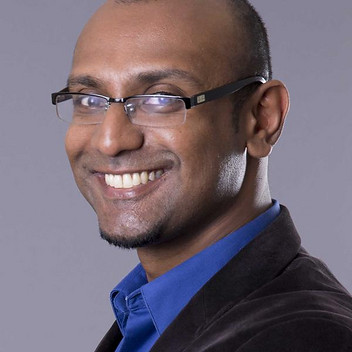
About Rajiv
Bio
Rajiv Maheswaran is the CEO and Co-Founder of Second Spectrum, a startup transforming sports through technology. He is also a Research Assistant Professor in the Computer Science Department and a Project Leader at the Information Sciences Institute at the University of Southern California where he co-founded and co-directs the Computational Behavior Group, which focuses on data-driven computational models to help understand human behavior and improve decision-making.
He received a B.S. degree in Applied Mathematics, Engineering and Physics from University of Wisconsin-Madison. He received M.S. and Ph.D. degrees in Electrical and Computer Engineering from the University of Illinois at Urbana-Champaign. His current interests focus on data analytics, visualization and real-time interaction to understand behavior in spatiotemporal domains, an important and emerging area that encompasses transportation, security, energy, and health among others.
In particular, he has made significant impact in the area of sports analytics. In this area, he has won both the 2014 MIT Sloan Sports Analytics Conference Best Research Paper Prize and the 2012 MIT Sloan Sports Analytics Conference Best Research Paper Prize. Software created by Second Spectrum has been used by multiple professional sports teams and multiple professional sports leagues.
His focus on turning their research towards practical use was also recognized by USC with the 2014 USC Viterbi School of Engineering Use-Inspired Research Award as well as in the leading intelligent agents conference: the International Joint Conference on Autonomous Agents and Multi-Agent Systems with the 2011 AAMAS Best Demonstration Award and the 2010 AAMAS Best Demonstration Award.
In addition to sports, he have contributed to other important spatiotemporal domains:
• Safety/Security (Los Angeles Fire Department): helped analyze the LAFD fire response time data and served as advisors to the LAFD Task Force on Information and Data Analysis.
• Safety/Security: (Los Angeles Police Department): worked with data supplied the LAPD to see if geospatial social media could predict gang networks in Los Angeles.
• Education (USC Hybrid High Charter School): worked with USC Schools of Cinema and Education to increase STEM engagement through alternate reality games deployed in an LA-charter high school where spatiotemporal pattern recognition can be used to identify students’ behaviors and ultimately automatically create appropriate interventions.
• Energy: instrumented their labs and worked with USC Facilities to instrument classrooms to understand the spatiotemporal patterns of various spaces within USC in order to optimize energy usage for heating and cooling of these spaces.
• Health: worked with USC GamePipe Lab to create an augmented reality game that tracked movements of players across the USC campus in order to study how to place objectives and learn spatiotemporal behavior models to encourage more physical activity.
• Transportation: worked with the USC Transportation Office and Campus Cruisers to study and identify drivers by their behavior.
• Society: used public geo-tagged social media to build models of racial segregation and mobility dynamics in New York, Los Angeles and Chicago.
His work has been featured in major media outlets including NPR, ESPN.com, The Los Angeles Times, KPCC AirTalk, Yahoo Sports, Sports Illustrated online, NBA.com and many others. IBM independently sponsored the creation of a video about his research as an exemplar of how data analytics can bring about insights that can transform an industry.