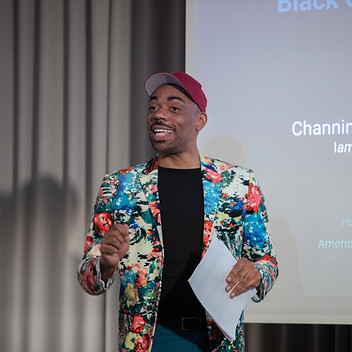
About Channing Gerard
I am a…
Artist, Educator/Teacher, Gay, Global soul, Journalist, Writer/Editor
Bio
Channing Gerard Joseph is Ferris Professor of Journalism at Princeton University. He is renowned for his pioneering research on Black LGBTQ+ history, which brings to light forgotten stories of queer African Americans' resilience, resistance, and joy. He is also the discoverer of William Dorsey Swann, the world’s first documented drag queen and the leader of America’s earliest-known queer resistance group.
Joseph’s innovative historical research has been recognized by the U.S. National Archives and the Smithsonian National Museum of African American History & Culture. In 2022, TED honored him as a TED Fellow — one of 20 global “visionaries” whose work is sparking “future-shaping change around the world.”
Joseph has appeared on CBS This Morning, Comedy Central's The Daily Show, BBC World News, Germany's Deutsche Welle, and Canada's CBC, among other international media outlets. His work also garnered a number of prestigious honors, including awards and fellowships from the American Academy in Berlin, Harvard University, Columbia University, and the Whiting Foundation, among others.
An award-winning journalist, Joseph's writing has appeared in The New York Times, The Nation, The Oxford American, and many other periodicals.
Through storytelling and scholarship, Joseph reshapes public understanding of queer and African American history, inspiring audiences to reflect on identity, justice, and the power of overlooked voices to change the world.
I'm passionate about
In addition to history and journalism, I'm passionate about using speculative fiction—particularly Afro-futurist works like the novels of Octavia Butler—to empower marginalized communities, especially Black queer people, to imagine themselves thriving in futures shaped by justice and possibility.
An idea worth spreading
Former slaves started the fight for LGBTQ+ rights in the United States.
Areas of expertise
19th century history, African American culture, African American history, black culture, black history, drag, education, history, human rights, journalism, lgbt, lgbt+, lgbtia+, lgbtq, lgbtq+, LGBTQ+ culture, lgbtqia, LGBTQIA+ rights, media, media justice, queer, queer culture, queer history, racial justice, representation, Slavery
The TED story
I was a nerdy gay Black kid. I yearned to escape my own skin. In the 2nd grade, I got my first chance to be someone else in a Thanksgiving play: I was cast as a pilgrim. In the play — which was my first exposure to U.S. history — slavery wasn't mentioned. Native people played only a minor part. Queer folk were invisible. The message I got: People like me weren't part of U.S. history.
Many years later, as a grad student, I learned I was wrong when I found an 1888 Washington Post article with the headline: "A Negro Dive Raided. Thirteen Colored Men Dressed as Women Surprised at Supper and Arrested." The leader, a former slave, had gone down fighting in his "gorgeous dress of cream-colored satin." It blew my mind to see that people like me were part of history after all; it's just that no one knew their stories.
It eventually became my passion: uncovering the lost history of how queer former slaves shaped our culture.
People don't know I'm good at
Acting, Dramatic Readings, Drawing, Singing