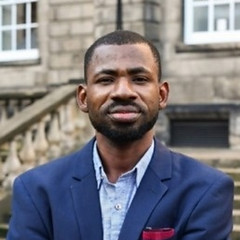
About Ifeanyi
I am a…
Christian, Public servant, Scientist, Student
I'm passionate about
Improving health at the population level has been my greatest motivation; especially as I observed that the basic health problems of the poorest and the most vulnerable communities are mostly unmet. I was born and raised in a remote community where access to health care facilities is greatly limited. This experience has nailed down a very significant passion for health within me. In 2017, following my appointment as Tutors at the College of Nursing, where I have successfully trained over 500 nursing students and 200 community midwives in the last two years. Later in 2019, I formed alliances with about ten qualified medical doctors and 50 paramedics from the National Youth Services Corps (NYSC), to appraise rural health care delivery through community health workforce training, and free medical outreaches. I also used a one-hour radio programme slot allotted to me at the Rima Radio 97.1 FM sokoto State from 2018-2019 to promote health monthly. In 2019, I was appointed as a Lecturer at the Nnamdi Azikiwe University (NAU). Till date my research teams are addressing gross ignorant and deleterious cord care practice among the rural populace of the eastern Nigeria. I am currently a Mastercard foundation scholar studying master’s in Global Health Policy at the University of Edinburgh. As a master’s student, I was recently elected as the Postgraduate Taught Representative of over 15,000 PG students, followed by an appointment to become a committee member of the University Library and Edinburgh Future institute.
An idea worth spreading
The proposed theme for our event is “The Inside Story of a New Millennium”, which encompasses a set of 4 ideas, namely: The Future of Artificial Intelligence/Technology in Human Evolution; Global Health and Policy in a pandemic world; Education in lockdown; The Release and Relish of Values and Culture.
Each idea is specifically defined thus:
1. The future of AI in human Evolution: In the wake of the pandemic, the world stopped spinning. Technology became the only lifeline to keep it moving. This scenario made technology more useful to even the least evolved as it is to the most educated lives on our planet. With this, the world became open to the dire need to build supercomputers, higher bandwidth, super-intelligent machines, /Artificial intelligence to enhance our output and make the world more interconnected. Following these antecedents, speakers are invited to reflect on the future of AI in genomic science, cyborgs, control of infectious diseases, global health security, poverty eradication, security, peace, and human development. They will highlight the invisible possibilities of technology and problems that could confront humanity and our planet with their use. Emphasis on the ethics of AI, who funds it, for whom it is defined (and for whom it is not), who can have access to it, the posthumanism/transhumanism. Finally, as the global focus delves into the long-neglected topic of inclusivity, inequality, and social injustice, data are needed to quantify and convince policymakers on their existence and measure progress. However, we depend on AI to do this modelling. Speakers will reflect on biased predictions, as training data might not represent the sample or might reflect already held prejudices.
2. Global health and policy in a pandemic World: COVID-19 has underscored, and posed a challenge to, the intricate web of institutions, policies, and actors that make up healthcare systems around the world. Within the huge field of global health, accessibility has emerged as one of the most salient issues. This includes open access to scientific research for healthcare practitioners in high-risk regions and the availability of epidemiological data for monitoring the spread of disease, as well as equitable access to vaccines both within and between countries and the security of global supply chains. Politics, policy, bilateral and multilateral institutions like the WHO have a vital role to play in addressing these concerns. Therefore, as university community, we are clearly interested and invested in research, and through research and facts we must show the world the promise land and what we must do, to get there. Speakers are welcome to reflects on what COVID-19 has thought the world, and how to strengthen global solidarity, global health policies, and technological tools needed to disrupt the current narratives of inequity and devastation of COVID-19. Above all how these tools could be deployed to identify, prepare, and respond, to possible future pandemic.
3. Education in Lockdown: As countries worldwide learn how to mitigate the impact of the pandemic, entirely novel methods, and practices of conducting education and learning have arisen and continue to be discovered. Most notable, is the role of technology, that morphed from being a convenient bonus to our learning to the central platform and direct extension on which education takes place. In consideration of education, speakers are welcomed to reflect on the use of virtual reality in education. The development of new technology that can help alleviate some of the problems facing education today, discuss how effective lockdown education has been across different countries, and consider the gap between education across other sectors and ages. Online educational content creators, psychology experts, teachers and students alike should have the opportunity to share their research and experiences of the dramatic shift to the way social interactions in educational settings changed, the impact of inequality in education and have the chance to shed light on how we can adapt for the future learning taking place in the new reality of online learning.
4. The release and relish of our values and culture: COVID-19 did not only challenge the worlds long held cultural practices, beliefs, and values, but rather put a pause to the conventional ways they are observed. On this note, speakers are invited to reflect on the impact of the COVID-19 on non-conventional observance of countries festivals and cultural activities on economies, national unity, and global solidarity spirits that such activities amplify and represent in a diverse group. Similarly, art has become more virtual over the pandemic. How does this affect the spread of art and culture, and how does this improve or impede the vibrant and imaginative sense of how humanity understand societal transformations and uncertain futures that undermines the work of arts. Finally, acknowledge the historical and
The TED story
In my first semester as a Global Health policy student at the University of Edinburgh. I was traumatized by the level of divide and damage the Covid-19 pandemic has done to global solidarity, life, and livelihoods as we know it. And given my current position as the Postgraduate Taught Representative in a university of over 18, 000 international students, I see it as an opportunity to organise the TEDxUniversityofEdinburgh to foster global solidarity among the next generation of global influencers. Furthermore, TEDx is a platform to bring bright minds both young and old to discuss our differences and to reach a common ground where all of us irrespective of race can build ourselves a new millennium of solidarity despite shock. Also, the fact that the University of Edinburgh has not hosted TEDx for the past four years has strengthened my motivation to revive it in such a time as this pandemic, redefining our world.
Things you might not know
I am an introverted individual who lives more on the pages of a book than I live in this real world. I love ideas and I am most fascinated with innovations in biological sciences and engineering with great proclivity for mathematics(numbers). I write fiction in my spare time and I enjoy listening to classical music that is heavy with poetic lyrics. I love people and cherish every moment I spend with them, especially people that help me see the world from a different lens.