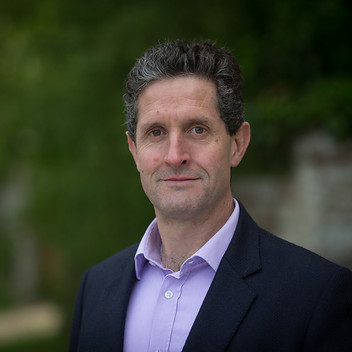
About Myles
I am a…
Educator/Teacher, Scientist
Bio
Recently described by the BBC as "the physicist behind net zero," Myles Allen developed the methods used by the Intergovernmental Panel on Climate Change (IPCC) in 2001 to quantify the size of human influence on observed and projected changes in global temperature. He founded the climateprediction.net project, enabling members of the public to volunteer computing resources to run the world's largest climate modeling experiments, and in 2003 he proposed how probabilities could be used to assign responsibility for individual extreme weather events. In 2010 he was awarded the Appleton Medal and Prize from the Institute of Physics "for his important contributions to the detection and attribution of human influence on climate and quantifying uncertainty in climate predictions."
At a conference in 2005, Allen first proposed the concept of a global carbon budget: the idea that peak warming is determined by the total amount of carbon dioxide we emit into the atmosphere before emissions are reduced to net zero, not the amount we emit in any given year or the eventual long-term atmospheric concentration. He has been working on the implications for climate policy ever since, most recently as coordinating lead author for the 2018 IPCC Special Report on 1.5 degrees, and has long been a proponent of fossil fuel producers taking responsibility for cleaning up after the products they sell, rather than placing the onus on relatively powerless consumers.
Allen works and lectures in the School of Geography and the Environment and the Department of Physics, University of Oxford. He is a Fellow of Linacre College and is married to Professor Irene Tracey, a world-leading neuroscientist and warden of Merton College. They have three wonderful children and recently acquired a lockdown puppy.
I'm passionate about
Stopping fossil fuels from causing global warming.
An idea worth spreading
The only way to stop fossil fuels from causing global warming is to oblige anyone extracting or selling fossil fuels to ensure that one tonne of carbon dioxide is safely and permanently disposed of for every tonne generated by the fuels they extract or sell. This is called the Carbon Takeback Obligation (https://carbontakeback.org) and should be an integral part of every country's and company's Net Zero strategy.
Areas of expertise
Climate change, Climate policy, Extreme weather