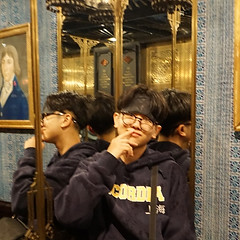
About Minh Anh (Andrew)
I am a…
Student
I'm passionate about
Social Problem
An idea worth spreading
Ancient Wisdom for Leaders
Morning, everyone! How is everyone doing?. I am so happy to see you all here. We have been through a hard time, fighting with the COVID-19, and we’ve made it so far — everyone deserves a thumbs up. My name is Nguyen Minh Anh, a rising 10th-grader at Concordia International School, and fun fact, I am a former student of Vinschool. It is my pleasure to come back here to join this event. There are a thousand reasons for me to join TED, but the two main reasons are: Vinschool because I want to see it again; and to fulfill my dream of becoming a TED speaker.
Vinschool introduced me to the road of learning about leadership. I never expected to have that quality in me, not even once before getting into Vinschool. But I was totally wrong about it. Vinschool enabled me to catch a glimpse of what was hidden inside me. In grade 6, after an argument with a classmate, I started to wonder “what are the qualities needed to be a successful leader?” Since leadership is such an abstract concept, to be able to define a “good” leader is not an easy task. The idea kept running in my mind, and one day I finally found out the key ingredients of a leader. It is simple, yet amazing. It is called the Modes of Persuasion. I first got this idea from a book called Leadership Genius but they were also the three original ideas of Aristotle: “Logos”, “Ethos” and “Pathos”. But what do these three words mean?
First, the word “logos”. From the Greek word “logos” we get the English word “logic”. The original meaning of Aristotle is “a reasonable word”. Personally, I think reasonableness is a quality that most people would want to see in a leader. Just a simple question, would you follow a leader that does not have a logical plan, or if whatever he or she says is unreasonable? I am sure that there will be a lot of “No’s” around here. Of course, you won’t follow people who talk nonsense and stay silent when it comes to solving a problem.
What I do to prove that my team should trust me is this: I make a clear plan and show it to everyone to make sure that everyone is on board. I want to use one of my small recent projects as an example. It was a one-week project. The very first thing that I do is that I need to write down the purposes of the project, as well as our aims. The purpose of this project was to discover the history of Mesoamerica, and we aimed to go as deep as possible. For the action part, I assign jobs to each team member equally. I make sure to check their progress by setting each individual deadline. There is no such thing as a perfect plan, as a result, things might not go smoothly. I need to visualize beforehand what kind of troubles we might get in, like; the internet, lack of information, and anything that could interfere with the progression. Then I need solutions to tackle it, and those solutions should be relevant, not like those simple math questions where they ask you how many sheep are on the boat to solve how big the sun is. What I’m trying to express here is: do everything logically and thoughtfully to influence people.
Moving on to the second part, ethos! From this Greek word comes the English word “ethics”. Aristotle believed that leaders have influence because they are experts. We tend to follow professionals or experts because they are credible. Why does everyone believe doctors? Because they know what they are doing, and that “ Dr.” badge on their chests authorizes them to be “authentic” doctors. That is an example, of course. You do not need to be a doctor to have credibility. How can someone build their own credibility? Use “proper” words. People will not trust a leader that always sounds like he or she is not educated. Credibility matters; build it by being formal and impartial. Be unbiased, this is truly hard to do because it is human nature to be biased, but being fair is necessary to balance a group and not create tension among the members. Be professional! How do I do it? I consider myself as a friendly one when I am not serious. However, when it comes to being a leader, I have to be professional. I do not joke around, but rather stay focused on the goal ahead of me. Focus gives others the feeling of being serious at work, and they will also do that.
The last one, pathos, means “emotion” but it is mainly about “appeals to emotion and empathy”. Pathos requires you to understand other people, their feelings. We are humans and emotion is an important part of us. Try to understand others and really care about them. You have to be the “therapist” of the team, to understand and help find a way to make things work. I have experienced enough to see the importance of this quality. Two years ago, I was a leader of a team in a competition. Everything was good, but when it came to understanding the emotion of one teammate, I didn’t handle it well. That person had gone through hardships, but I did not try to comprehend
The TED story
I was invited to participate by one of my best friends. She is an amazing person by the way. I wrote a short essay for the first round. I thought I am about to get kicked off because it was bad but I passed the first round (surprisingly). For the second round, I did an amazing interview so I passed the second round and officially became a TEDx Speaker. I trained 30 minutes every night to get my speech smooth. On D-day, I thought I did an impressive job but my speech did not go viral because the idea was not common. However, I am happy with myself and now I am a TEDx Organiser.
Things you might not know
Humorous