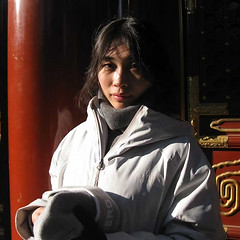
About Connie
I am a…
Activist, Artist, Designer, Idea generator, Producer, Student
Bio
Diana, a shampoo bottle in my bathroom, is my first actress. I tilt her, my toothpaste, and mom’s perfume in different directions, crafting my first tiny theatre as a naïve director. I become Laura in the Glass Menagerie; she plays with her glass animals, and I play with my plastic bottles: We both create stories in our mind.
Conversely, I bring stories to reality. I wrote plays in school revealing love, joys, and sorrows in adolescence, family, and marginalized communities; I directed the plays, guiding club members in blocking and empathizing with the characters. I acted in my own and others’ plays, tasting the lives of an ambitious queen, a loyal friend who has cancer, a calm but powerful boy leader, and an arrogant but vulnerable mom. I interacted with my acting partners from the characters’ perspectives, breathing for the resonance between me and them. In my script analyses and collaboration with different actors, I realized a golden rule. Acting is not purposeless screaming. It is, by nature, revealing the truthful responses elicited by an obstacle, conflict, and motive according to Sanford Meisner. Finding the actions behind lines of characters can bring genuine tears, smiles, or the honest connections between the characters and myself.
Voice, however, is not the only expression for Arts. Through the Williamson & Suzuki movements classes, I learnt the most enchanting part of theatre—movements. As the NYU professor Parker told me, there are stories integrated in my body, and sports training like tennis and dance shapes my body into a creative vessel. Following my impulses to move can truthfully bring out those hidden tales. During my first class with him, he asked us to create statues in one second. Creating movements usually took time for me; I cared about audiences’ views toward my creation, and I spent day and night refining my movements. Such practice of creating statues heated up my fear, but I decided to listen to Parker’s advice and follow my impulses. On that day, I turned my fear and uncertainty into a twisted statue, trusting my body to create freely and released my energy. Such processes broke away the chain that used to restrain my body, breaking it and reaching a new way to produce movements with impulses. I used the techniques to choreograph my movement pieces outside the classroom, transforming English poems into a kick, glide, or wring. I changed my movements’ tempos, delivering a Chinese poem to represent water’s different forms: solid, liquid, and vapor. Voice is not the only component of theatre. Our wrists, legs, or even just fingers can create theatrical pieces.
Trainings and performances shift my role from a lonely actress to a director, choreographer, stage technician, International Thespian Troupe member, and producer surrounded by lovely individuals of all talents. I am curious to explore more mediums like to convey stories in theater or even on stage through speech, and of course, no more shampoo bottles.
I'm passionate about
Despite my respect for movement and silence, I’ve found that some stories need words. That realization led me to immerse myself in media studies.
My relationship with “media” started on stage, as I became adept at marketing shows and designing posters.. But it expanded when I was asked to debate whether social media helped or hindered social justice. Since I’d used social media to preserve culture by filming a documentary on the Tanka fishing community and sharing interviews with the proprietor of Beijing’s vanishing Hutong food stalls, I found the assignment jarring. Could something I’d trusted to host uplifting stories also cause harm? That tension became fertile ground, which led me to the NYT Summer Academy. I became fascinated by investigative journalism and met advocates who used media to have a real-world impact. I had a chance to interview Carl King, a wrongful conviction activist, who described the prison system as “crimes against humanity.” His work spotlighted those left to rot in jail because they couldn't afford bail while their cases languished in judicial purgatory. It was often media coverage, he told me, that raised public awareness of their stories and the kinds of issues they faced.
I wanted to do that kind of work. So, I joined the media team at Discourse, a platform that shares underrepresented stories. I remember scrolling through my phone when I found a post featuring an elderly Chinese weaver. Her culture was disappearing, but she was fighting back with the power of the platform. That post inspired me to become a media director, curating and sharing the brilliance of those who might otherwise be forgotten. But I also saw how virality often rewarded scandal over substance. A post I made on traditional folk weaving was buried under news about a body found near Taylor Swift’s mansion. Perhaps the social media skeptics had a point. So, I decided to join the Pioneer Research Program and study how media forms could build real community. My project analyzed racist backlash to casting in Disney films like The Little Mermaid and Snow White on Chinese platforms, noting that the complaints often carried an undertone of cultural anxiety and nostalgia. Next year, I want to study how media companies can tailor their campaigns to weather this kind of reactionary criticism while creating new communities that positively support these kinds of films.
An idea worth spreading
Believe in instinct. It creates art.
Areas of expertise
Dance, Speech & Debate, Tennis, theatre