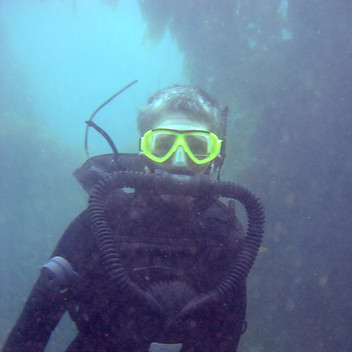
About Nathalie A.
I am a…
Explorer, Scientist, World traveler
Bio
Nathalie is a planetary scientist, an explorer, and a leader of research projects in astrobiology and extreme environments, planetary missions and robotics. She is a science team member of the NASA Mars Exploration Rover mission and was the main advocate for the selection of the Gusev crater as the landing site for the Spirit rover on Mars. She is the principal investigator and the expedition leader of the High Lakes Project, a NASA funded project exploring the highest volcanic lakes on Earth at close to 20,000 ft. Their exploration includes extreme scientific scuba and free diving and has brought new insights into poorly known and remote extreme ecosystems. Nathalie and her team document life adaptation to extreme environmental conditions and the effect of rapid climate change on habitability whether on present-day Earth or early Mars. She counts over 400 publications and professional communications. She has authored three books and several chapters of books. Her research is cited in the media and has been the focus of several TV documentaries.
EDUCATION: Graduated from the Lycée Corneille (France) and obtained her baccalaureat from the Academy of Versailles in 1982; received a license in physical geography in 1985 from the Nanterre University (France) with specialization in remote sensing, climatology, natural hazards, and hydrology; obtained her master in planetary sciences from the Sorbonne University, Paris, in 1986 and her Ph.D in planetary sciences from the same university in 1991. After two years of post-doctoral studies at the Observatory of Paris-Meudon, she was invited to work at the NASA Ames Research Center in California in 1994 with a post-doctoral grant from the French Ministry of Research. Selected as a National Research Council Fellow in 1996, she started developing exploration strategies for robotic and human planetary missions at NASA Ames. Since 1998, she is a senior research scientist at the SETI Institute Carl Sagan Center and a contractor of the NASA Ames Research Center where her office is located at the Space Science & Astrobiology Division. She has become a US citizen in 2006.
SPECIAL HONORS: New zooplankton species from the Licancabur lake named after Cabrol; Cambridge Who’s Who lifetime member, registry of executives, professionals, and entrepreneurs (2009); NASA Group Achievement Award for the Mars Exploration Rover third and fourth extended mission (2008); Elected Wings WorldQuest Fellow (2007); NASA Ames Research Center award for excellence as a contractor employee (2005); NASA Group Achievement Award for the Mars Exploration Rover extended mission for science and for science support team (2005); Elected Women of Discovery (Air & Space), Carey Fellow, Wings Worldquest (2005); NASA Group Achievement Award for the Mars Exploration Rover mission science team and science operation team (2004); Gold medal, International Water and Science Award, UNESCO/European Parliament (2000); NASA Ames Research Center Space Science Division Outstanding Achievement Award (1999); NASA Johnson Space Center Group Achievement Award for the Astronaut-Rover (ASRO) field experiment (1999).
EXPERIENCE: Exploration, whatever its focus, is limitless, multi-facetted, and exquisitely complex. The understanding of how and why planets evolve, whether they could have hosted favorable habitats for life, how climate change impacts their habitability - and for Earth, its biodiversity - are questions that need to be addressed through a synergetic approach by looking at many different and complementary angles simultaneously. Nathalie’s vision of exploration reflects this philosophy. A planetary geologist by training, she realized early in her career that understanding the potential and constraints of robotic exploration was critical to provide useful feedback to rover engineers for the selection of landing sites on Mars or any other planet. As a result, she started designing and testing science exploration strategies for rovers in terrestrial analogs to planetary terrains. At the same time, she developed assessment studies for candidate landing-sites for Mars, resulting in the selection of Gusev crater as the landing site for the rover Spirit in 2003. She explores terrestrial extreme environments analogous to Mars in order to understand whether early Mars was habitable, if life did have a chance to develop, and to survive when climate changed 3.5 billion years ago. Her current research projects include the High Lakes Project, the Mars Exploration Rover mission, and planetary analog projects. Sharing the excitement of exploration and discovery in planetary exploration is paramount in Nathalie’s career. She started giving public lectures at age 23. She now counts over 400 lectures in the USA and France, including a broad range of audiences. She also trains the next generation of explorers and scientists by involving them in her scientific expeditions and planetary research.
I'm passionate about
I am passionate about exploring all things unknown, opening new paths where there were none before, and expanding our understanding of this universe and what our place is in it.
An idea worth spreading
It's not the things we do that make life beautiful, not even the most extraordinary ones, but the people we do them for – or with. There is emptiness in the most beautiful night sky if it is not shared.
Areas of expertise
extreme environment, planetary science, geology, remote sensing imaging systems
People don't know I'm good at
Diving, mountaineering, and kayaking.