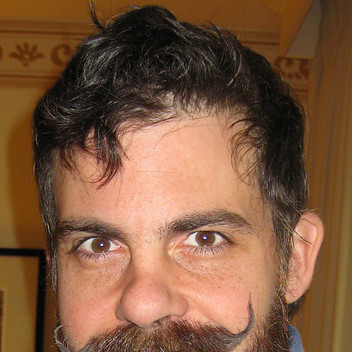
About David
I am a…
Agnostic, Artist, Brainstormer, Doctor, Entrepreneur, Inventor, Scientist
Bio
Dr. David Hanson develops human-like robots with realistic facial expressions and conversational abilities. In 2003, Hanson founded Hanson Robotics to pursue the development of friendly super-intelligent machines, with the premise that intelligent characters would give rise to empathy in machines. To realize such intelligent character robotics, Hanson has addressed hardware, software, cognitive/perceptual, and artistic challenges related to character robotics. To enable complete, walking, battery-powered androids, Hanson developed a patented skin material (“Frubber”), which affects hyper-naturalistic expressions with only a few watts power, thus requiring only small batteries and tiny motors to make a full range of facial expressions. In November 2005, Hanson demonstrated these benefits with a walking, expressive portrait of Albert Einstein, mounted atop the KAIST Hubo walking humanoid robot. To achieve naturalistic human-robot interactions, Hanson and team devised the Character Engine cognitive software, which brings eye-contact, speech recognition, natural language responses, and film-quality animation of robots together in a flexible, modular framework. In 2005, Hanson and team received an AAAI award for their "intelligent conversational portrait" of Philip K. Dick [AI Magazine, Fall 2005]. Hanson later developed low-cost versions of these technologies, with the walking, expressive character robot named “Zeno, Hero of the Singularity”, for commercial release in 2010. Hanson has also conducted numerous cognitive science experiments, testing human response to humanlike robots.
Hanson publishes regularly in materials science, artificial intelligence, cognitive science, and robotics journals, including SPIE, IEEE, the International Journal of Cognitive Science, IROS, AAAI and AI magazine. He has been featured in numerous popular media outlets including NY Times, Popular Science, Scientific American, the BBC and CNN. Both WIRED and PC Magazine declared Hanson’s robots to be works of “genius”, and Science named Hanson “head of his class” in social robotics. At Walt Disney Imagineering, Hanson worked as both a sculptor and a technical consultant. Hanson has received awards in both art and engineering, including co-receipt of an AAAI 1st Place prize, the Smithsonian Cooper Hewitt Triennial, a National Science Foundation STTR award, co-recipient of NASA's Space Act Award, WTN World Technology Award nomination and Innovator of the Year Award. Hanson co-chaired SPIE Symposium on artificial muscle actuators and has spoken at venues including IEEE, SPIE, AAAI, DARPA, MIT, Dartmouth, Brown, Google, Sandia Labs, UCSD and AAAS annual meeting. Hanson has shown in the Smithsonian Design Triennial, AAAS annual meeting, Reina Sophia museum (in collaboration with David Byrne), and at WIRED Nextfest Hanson received his BFA from Rhode Island School of Design in film/animation/video, and his Ph.D. from the University of Texas at Dallas in interactive arts and engineering. Hanson currently serves as chief scientist and CEO of Hanson Robotics.
Areas of expertise
Artificial Intelligence, robotics, sculpture
People don't know I'm good at
painting, poetry, psychoactive-party-architecture