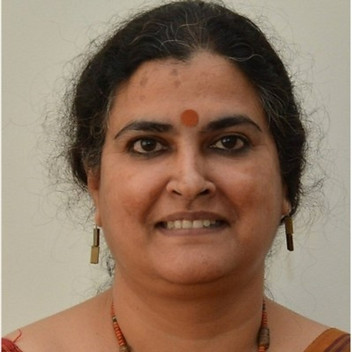
Aasha Sharma
Professor at Symbiosis Institute of operations management
TEDx Organizer
NASHIK, IndiaAbout Aasha
I am a…
Concerned citizen, Educator/Teacher, Explorer, Parent, Student
Bio
Aasha Sharma is an ardent academician with teaching and academic administration experience in various business schools for the past 23 years. She currently serves as a Professor, at Symbiosis Institute of Operations Management, under the Symbiosis International University, Pune, India. Though trained in the marketing domain with an MBA and PhD in this area, she believes in holistic learning and is popular for her approach to sensitizing students and connecting learning to a larger context. Her interest in sustainability studies is explicitly strengthened by her contribution to curriculum, research, and publications in sustainability. She strives to intersect marketing and sustainability in her research and is currently working on De Consumption for Sustainability, Green Consumerism, Circular economy, and developing Interventions for Responsible Consumption and has published Research articles related to these topics. She conducts Case Development Workshops and has published several teaching cases. She conducts MDPs and workshops on 'Design Thinking' and 'Circular Design Thinking' for Businesses and various interest groups.
She is also a PhD supervisor at Symbiosis International University, India.
Apart from teaching, she is in charge of Admissions, Head of Communication and Public Relations, and Faculty in charge of the Faculty Development Program at the current Organization. She also organizes TEDx for the institute.
I'm passionate about
Creating awareness on De Consumption! My efforts have been to talk about all the wrongs that consumption has done to us and our planet and how we can work individually and collectively work to reduce unnecessary Consumption. My research topics have been revolving around this topic and other related areas in the periphery like Recycling, Up cycling and Circular economy. I believe Systems and Design thinking are crucial for sustainable transitions of Businesses, Cities, and Communities. Systems, processes, laws, policies, business models, economies, lifestyles, and behaviors can all be designed and redesigned for the greater good.
An idea worth spreading
Can Human Race commit to adapt a De Consumption Culture : Consumer culture is no accident it has been one of the most striking trends over the past 100 years. As Victor lebow (1995) wrote in the Journal of retailing “Our enormously productive economy demands that we make consumption our way of life, that we convert the buying and use of goods into rituals, that we seek our spiritual satisfactions, our ego satisfactions, in consumption”. The mechanisms as well as impact of this call made in 1995 for shift to consumption culture are traceable in every economy today. The measure of social status, of social acceptance, of prestige, is now to be found in our consumptive patterns. The very meaning and significance of our lives today is expressed in consumptive terms. The greater the pressures upon the individual to conform to safe and accepted social standards, the more does he tend to express his aspirations and his individuality in terms of what he wears, drives, eats, his home, his car, his pattern of food serving, his hobbies. (Victor lebow, 1995).As Hofstede ( 1991) rightly puts it, Culture is learnt through social interactions, that culture is not genetic, that culture is shared by members of a specific society, and that culture is transmitted from generation to generation. Cultural influences on consumer behavior and consumption can be summarized as propensity to change (Sheth and Sethi, 1977). Cultural factors influence people’s purchase decision and have a strong impact on consumer behavior (Craig and Douglas, 2005).
If cultural factors influence purchase then can a culture that influences mindful consumption be cultivated? Can consumption culture be shifted to sustainability culture then? Can we all build a culture that calls for DE consumption?
Can we collectively work on another cultural shift?
Can the same media and other agents of communication who were responsible for influencing the current state of consumption be used for this transformation to De consumption culture? De-consumption can be described as a conscious limitation of consumption to the reasonable size, i.e. an amount of consumed products that results from natural, individual, physical and psychological characteristics of a consumer (Bywalec and Rudnicki 2002). Furthermore, from the individual point of view adopting the rules of de-consumption in everyday life requires certain change of culture or even the whole lifestyle transformation. Without it we are left with technology and policy solutions that do not fully fix the problem. With it, we may live lives that are not only healthier, but more equitable. A culture of sustainability is the fundamental requirement for saving the planet. Can we start gradually moving to a culture of De consumption?
The TED story
TED has been an integral part of learning and teaching journey of my life.The diverse ideas that TED beholds is like an interactive encyclopedia in itself.I have woven several TED talks as value add in my lectures while teaching Business School students.One of the most impressive ones and my favorites is DR. LEYLA ACAROGLU's TED Talk.
Things you might not know
Designing experiential learning modules that intend to work on behavioral transformation.