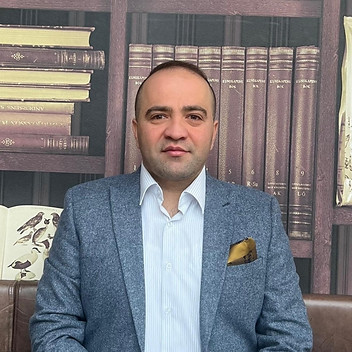
Ali Al Ibrahim
Award-winning investigative journalist focused on uncovering the truth and holding power accountable
FollowAbout Ali
I am a…
Business leader, Educator/Teacher, Idea generator, Journalist, Technologist
Bio
About Ali Al Ibrahim
Ali Al Ibrahim is an award-winning investigative journalist, AI researcher, and lecturer whose work bridges the worlds of data science, artificial intelligence, and investigative reporting. He is the founder of SIRAJ, an investigative journalism unit specializing in cross-border investigations and digital verification. With over fifteen years of experience, Ali has produced in-depth investigations into corruption, human rights violations, and financial crimes across the Middle East and beyond, collaborating with leading international media organizations including the BBC, The Guardian, and the OCCRP.
Ali’s work has earned multiple international recognitions, including the BBC Best Young Journalist Award, the Samir Kassir Award for Freedom of the Press, the FJA Outstanding Investigative Reporting Award (2022), and the AACR June L. Biedler Prize for Journalism (2023, USA). He is also recognized by the Global Investigative Journalism Network (GIJN) and serves as a TED Fellow and research fellow at the Oxford Centre for Journalism Studies.
Ali holds a Master of Science in Artificial Intelligence from the University of Wolverhampton, UK, and is preparing for PhD studies focused on the intersection of AI, journalism, and ethics. His doctoral project explores how AI can enhance investigative journalism through automated analysis, data mining, natural language processing, and network detection models, while addressing the ethical challenges of transparency, bias, and accountability.
In addition to his journalism career, Ali is the author of “Artificial Intelligence in Journalism: Ethics, Applications, and Investigative Innovation”, a book examining how AI can be ethically integrated into journalistic workflows. Since 2017, he has also worked as a consultant for the International Journalists’ Network (IJNet), publishing reports and toolkits on AI-driven investigations, data methodologies, and media ethics.
Ali’s work aims to transform how journalists use technology to expose truth and empower communities. By combining machine learning with investigative storytelling, he is pioneering a model of AI-powered journalism that enhances accuracy, transparency, and social impact.
I'm passionate about
I’m passionate about exploring how Artificial Intelligence can transform investigative journalism — not as a replacement for human judgment, but as an amplifier of truth, ethics, and accountability. My goal is to bridge the gap between technological innovation and journalistic integrity, ensuring that AI tools are used responsibly to expose corruption, detect disinformation, and uncover hidden power networks.
I believe the future of journalism lies in combining human empathy with algorithmic precision, using technology to enhance the journalist’s capacity to serve the public good and uphold democratic values.
An idea worth spreading
Artificial Intelligence is not just a tool for automation — it’s a lens to uncover hidden truths. In my work, I use AI to detect illicit financial flows, and reveal patterns hidden in massive datasets. But the true power of AI lies in augmenting human judgment, not replacing it. By combining computational intelligence with moral responsibility, we can create a journalism that is data-driven, transparent, and profoundly human. My idea is simple, yet transformative: AI can help us tell the truth better — but only if we remain its ethical guardians.
The TED story
I grew up in a place where truth was dangerous — where a story could cost you your life, and silence was the safest language. But I chose to speak. Journalism became my way of fighting back, a weapon made not of bullets, but of questions.
For years, I investigated power — its corruption, its cruelty, its silence. I uncovered secret prisons, exposed financial crimes, and documented the invisible wounds of war. Every story carried a risk, but also a promise: that truth, once revealed, could not be buried again.
Then a new kind of war began — one not fought in streets, but in algorithms. Disinformation spread faster than facts. Deepfakes blurred reality. The very idea of truth began to fracture.
That’s when I turned to Artificial Intelligence — not to replace the human heart of journalism, but to empower it. I began training machines to detect lies, trace money that funds violence, and reveal patterns hidden in chaos.
My TED journey is about reclaiming technology for truth. Because I believe AI can be humanity’s most powerful ally — if we teach it to serve justice, not power.
I am building a bridge between human courage and machine intelligence — a future where technology doesn’t silence truth, but amplifies it.
Because the most radical act of our time is still the same as it ever was: to tell the truth — and make it undeniable.
People don't know I'm good at
People don’t know that I specialize in using AI-powered data analysis to track cross-border corruption networks and illicit financial systems. I excel at applying machine learning, network analysis, and predictive modeling to uncover hidden connections that expose wrongdoing.
Beyond the algorithms, I’m also skilled at translating complex data into compelling human stories that resonate emotionally and intellectually. This unique balance between technical precision and narrative depth defines my approach — whether I’m analyzing millions of data points or interviewing survivors of injustice.
Ultimately, my strength lies in connecting technology with purpose: using Artificial Intelligence not just to process information, but to pursue truth, justice, and accountability.