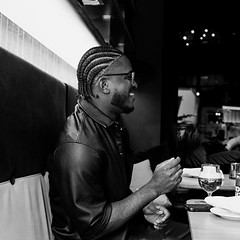
About Caleb
I am a…
Brainstormer, Connector, Foodie, Idea generator, Project manager, Scientist, Student
Bio
Caleb currently serves startups as at Underscore VC, where he conducts startup due diligence and sources early-stage founders across life sciences, fintech, and software/ai infra. He is a dynamic and mission-driven community strategist and community builder with over six years of curation and organizational leadership.
As the founder and Managing Director of TEDxHarvard Square, which he has built over seven years from a nine-person annual conference into a 70+ person organization running year-round programming at the intersection of technology, venture capital, and social impact with a platform totaling up to $800B in community value. Under his leadership, TEDxHarvard Square was selected to launch the first founder house in the tedx ecosystem.
His writing, published under Caleb in Tech on Substack, explores AI, labor economics, and geopolitics through a multidisciplinary lens — drawing on frameworks from cognitive science, moral philosophy, and political economy. He holds a background in neuroscience and trained at Harvard Medical School before moving into the operator and investor track.
I'm passionate about
startups, travel, and food
An idea worth spreading
“Information is what gets accumulated in a genome in the course of evolution. The sequence of bases in a DNA molecule correlates with the sequence of amino acids in the proteins that make up the organism’s body, and they got that sequence by structuring the organism’s ancestors – reducing their entropy – into the improbable configurations that allowed them to capture energy and grow and reproduce.” (20) Networks of neurons preserve information and “can transform it in ways that ... explain how brains can be intelligent. Their firing patters correspond to ... a statistical decision that depends on the weight of the incoming evidence.” Neural networks engage in information processing or computation. “A brain ... transforms the information about the world ... in a way that mirrors the laws governing that world, which in turn allows it to make useful inferences and predictions. Internal representations that reliably correlate with states of the world, and that participate in inferences that ... derive true implications from true premises, may be called knowledge.” (21) Placed in the context of evolution, “a brain wired by information in the genome to perform computations on information coming in from the senses could organize ... behavior in a way that allowed it to capture energy and resist entropy.” It becomes goal directed, cybernetic, feedback, control. “The idea explains how a physical system can appear to be teleological, that is, directed by purposes or goals. All it needs are a way of sensing the state of itself and its environment, a representation of a goal state, ... an ability to compute the difference between the current state and the goal state, and a repertoire of actions that are tagged with the typical effects.” (21) It is homeostatic. “The principles of information, computation, and control bridge the chasm between the physical world of cause and effect and the mental world of knowledge, intelligence and purpose. Ideas can change the world.”
Areas of expertise
community building, event strategy, fundraising, public speaking, stakeholder engagement, startups, talent identification, talent retention, venture capital
The TED story
introduced to the an infectious idea (TED-Ed) that took over my entire life
Things you might not know
ironman, cooking, planning trips